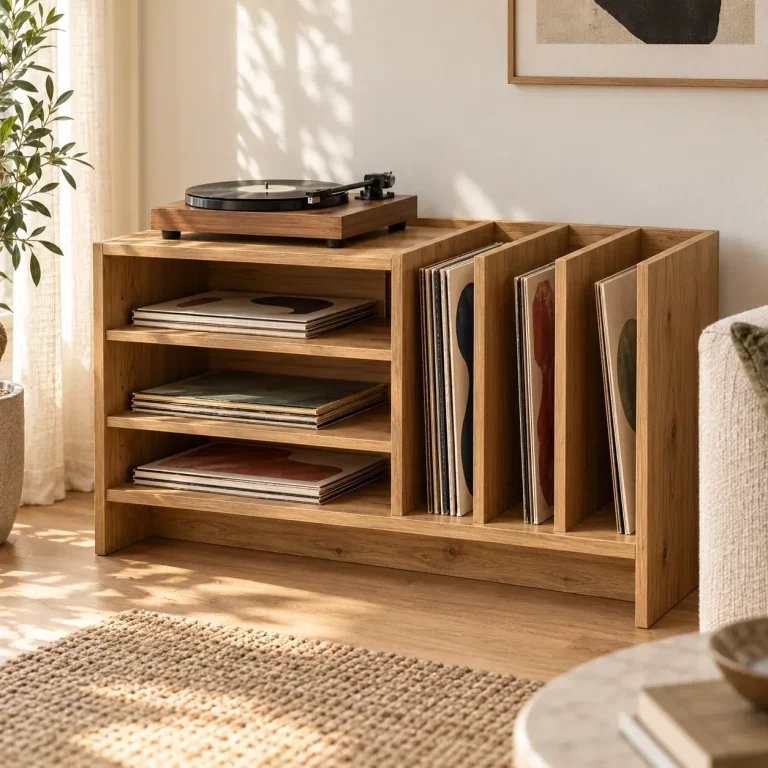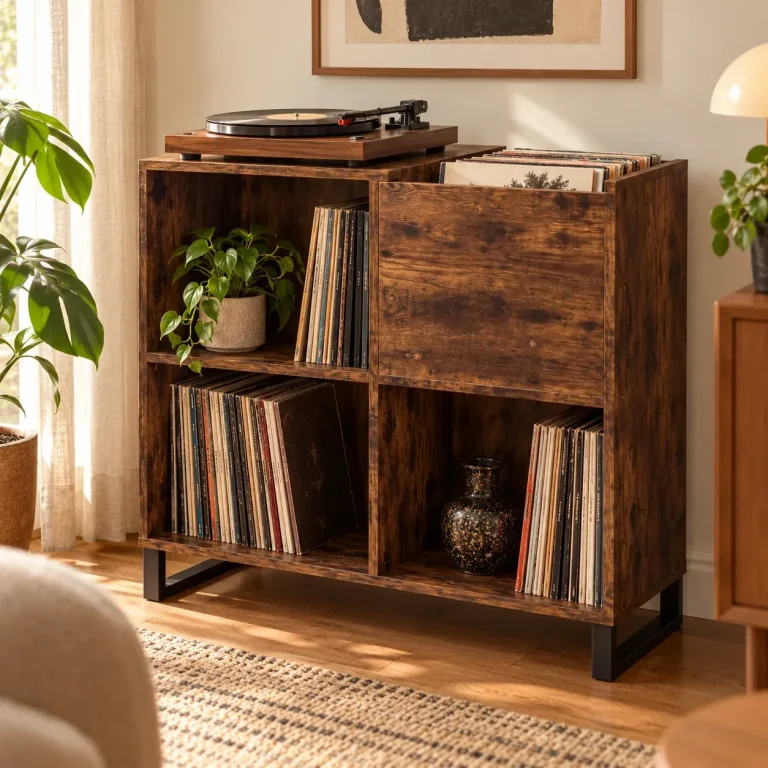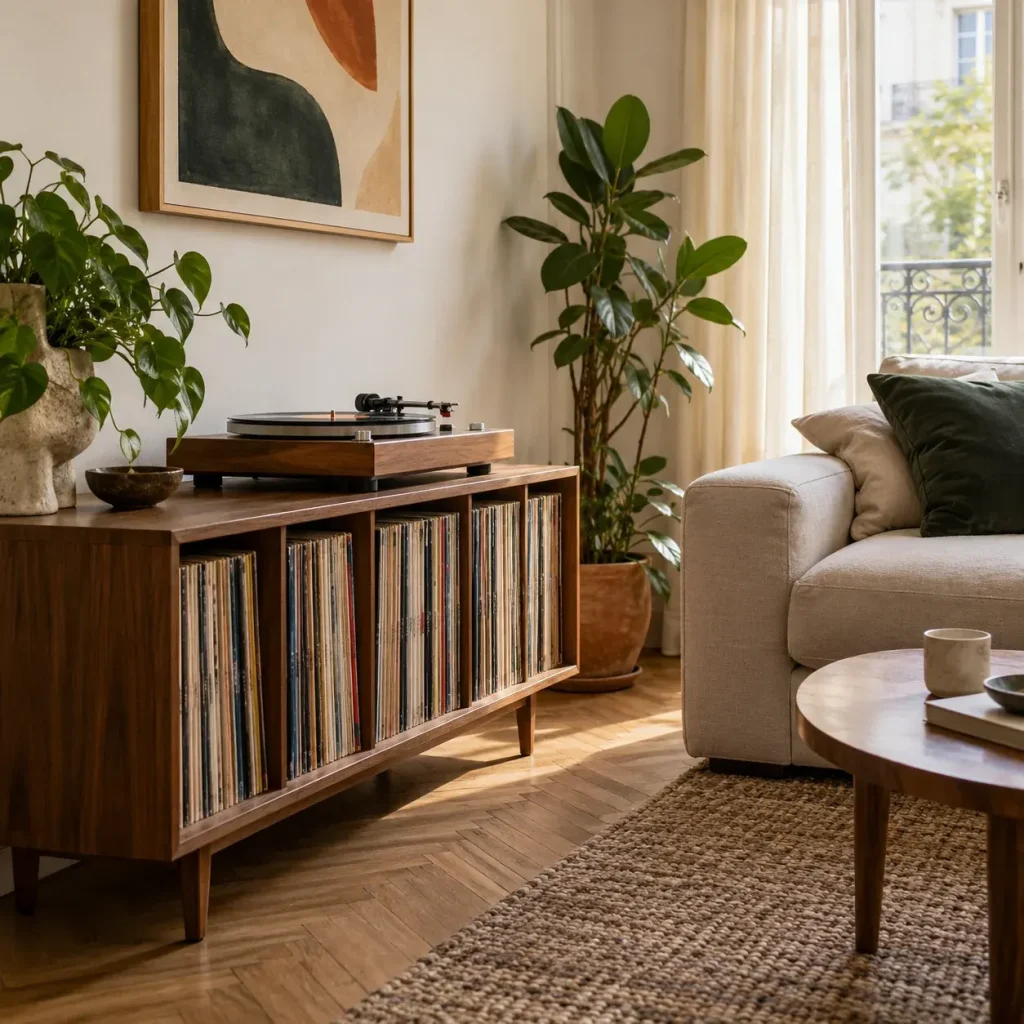
A turntable is not like other audio equipment. Its tonearm follows a groove just a few tens of microns wide, and anything that disturbs it, a sloping surface, a vibration, a knock, can be heard. The furniture it stands on therefore matters as much as where it sits in the room. Here are the criteria for choosing a record player stand that suits your equipment and the way you listen.
1. A top of the right size
Measure your turntable
Most home turntables take up around 45 × 35 cm. Compact models are smaller, while DJ-style direct-drive turntables are slightly larger and heavier. Measure yours, feet included, allowing for anything that sticks out: counterweight, sockets at the back, lever. Our turntable size guide brings together the common formats.
Compare it with the top
The width and depth of the top should exceed those of the turntable, with a few centimetres to spare. A turntable that overhangs at the front is likely to get knocked; at the back, the cables need room. On a unit 35 cm deep, check carefully: the margin is small.
The lid
If your turntable has a lid that opens upwards, you need clear height above the top, often around 40 cm. Avoid putting a shelf directly above: you would no longer be able to open it fully.
2. Listening height
It is a criterion that is often overlooked, yet it is what determines everyday comfort.
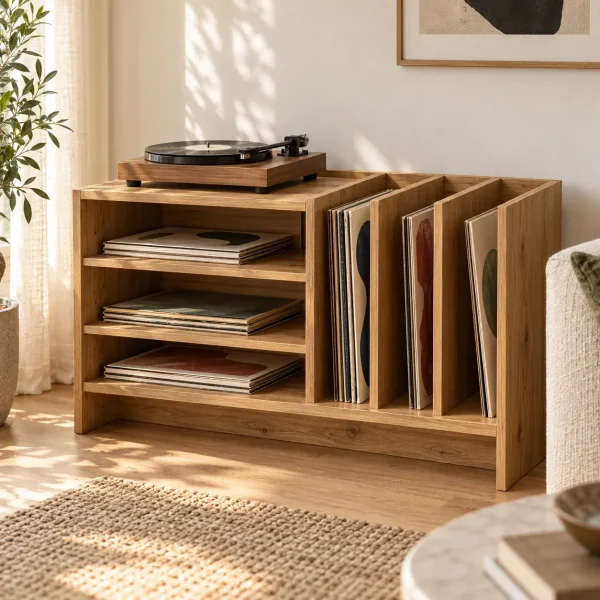
- A low unit, around 45 to 50 cm: the turntable stays visible from the sofa, and the unit slips under a window or a picture. You have to bend down a little to flip the record. Pigalle, 45 cm high, works this way.
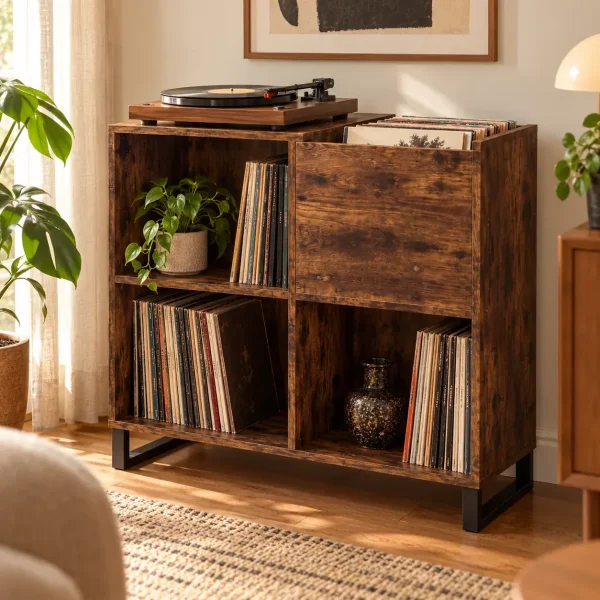
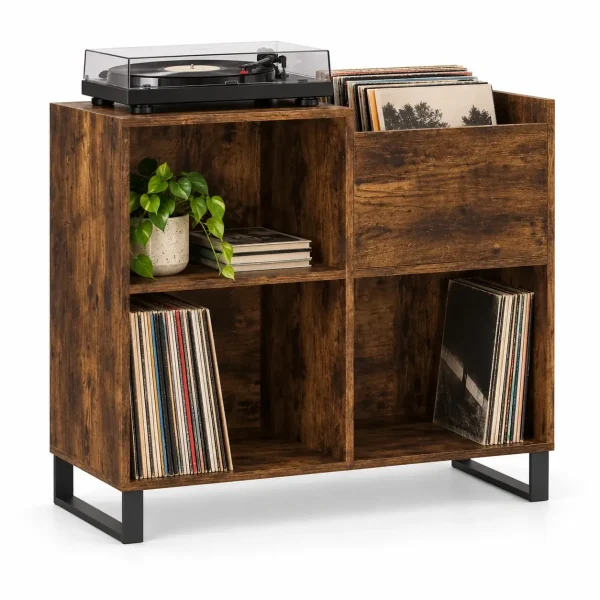
- A tall unit, around 75 to 90 cm: the turntable sits at hand height, so you can handle it standing up without bending. Montmartre, 89 cm, combines this high top with 4 large square compartments.
Ask yourself a simple question: do you tend to listen seated, facing the turntable, or on the go, standing up and changing records often?
3. Stability and vibration
A level top
A turntable must sit perfectly flat. A sloping top throws off the arm and can wear the record unevenly. After assembly, check the unit is level with a spirit level, then check the turntable itself.
Furniture that stays put
The unit must stand firmly on the floor, without rocking. On a resonant wooden floor, place it close to a load-bearing wall if possible. A unit on castors must have its castors locked while you listen.
Speakers at a distance
Speakers vibrate, especially in the bass. Placed on the same top as the turntable, they can pass those vibrations on to the stylus and cause feedback or a muddy sound. Choose speaker stands or a separate surface, and keep them away from the turntable.
4. Room for the amplifier
Unless your turntable has a built-in preamp and connects to active speakers, you will have an amplifier. It needs to stay close to the turntable, as the phono cable is short.
- Measure the amp: a standard hi-fi model is often a little over 40 cm wide.
- Add room for cables at the back.
- Plan for an open recess, with air above and behind: an amp gets warm.
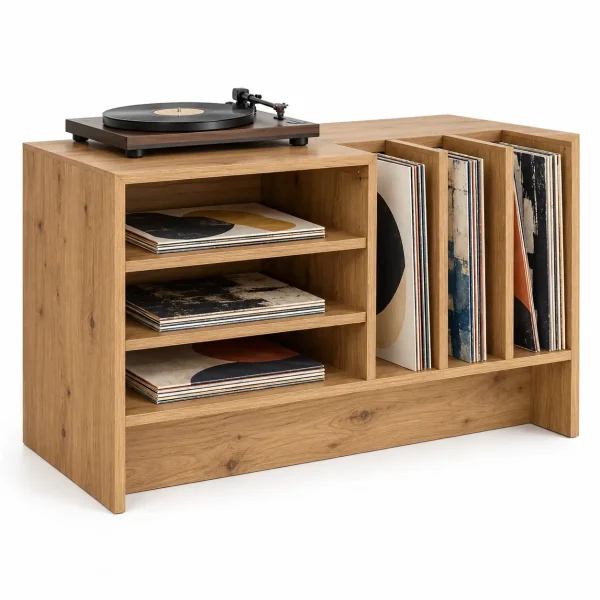
Models designed around the amp are gathered in our hi-fi furniture selection. On Batignolles, for example, two open recesses on the right take the components, next to a large record compartment behind a door.
5. Record storage
Compartments sized for LPs
An LP sleeve measures about 31.5 cm square. Compartments therefore need at least 32 cm of height and depth. Vertical compartments, where records stand upright, are the most practical.
Estimating capacity
Allow roughly 1 cm of width for 3 to 4 records, depending on their weight. Leave some margin: a collection always grows. If your record player stand is no longer enough, add dedicated vinyl record storage.
6. The right format for the room
- Living room: a low console or a sideboard, possibly long enough to take the screen. See TV and hi-fi units.
- Bedroom or studio flat: a narrow, taller unit that frees up floor space. See small record cabinets.
- Home office: a compact unit placed next to the desk, within reach.
7. Finish and style
Once the technical criteria are sorted, it is down to taste. Light oaks for a bright interior, smoked oak or rustic wood for more warmth, white or concrete grey to blend in, black for a graphic look. Splayed legs evoke 1960s furniture, while slim or hairpin legs lighten the silhouette. For a retro feel, see our vintage record cabinets.
8. Assembly
Most furniture is delivered flat-packed for assembly, with instructions. Assemble it close to where it will stand, on a protected surface. If wall fixing is provided for, use screws and wall plugs suited to your wall. Set the turntable up last, once the unit is level.
Checklist before you order
- The turntable’s dimensions, including the open lid.
- The width available on the wall, allowing for sockets and radiators.
- Your preferred listening height.
- The amp’s dimensions and room for cables.
- The number of records to store, with some margin.
- Where the speakers will go.
- The finish that suits the room.
With these seven points in mind, browse our record player stands collection: each product page gives the dimensions as W × D × H and, where known, the record capacity.