Choosing your first turntable can quickly feel daunting: belt or direct drive, preamp, cartridge, counterweight, anti-skate… Yet a handful of criteria is all you need to make a confident choice that suits how you listen and the kit you already own. Here is what to look for in a good turntable for beginners, followed by how to set it up so it sounds right and lasts.
Start with how you will listen
Before you get into the specs, ask yourself three questions:
- What will you listen through? A hi-fi system with an amplifier, active speakers, headphones, a Bluetooth speaker?
- Which records? Mostly LPs at 33, or 45s as well?
- How hands-on do you want to be? Do you simply want to drop the record on and listen, or learn to fine-tune your turntable?
Your answers will steer most of the choices that follow.
How to choose a turntable: the key criteria
The drive: belt or direct
The platter can be driven in two ways.
- Belt drive: the motor sits off to one side and turns the platter via a rubber belt. This layout isolates the platter well from motor vibration. It is the most common design on turntables built for listening at home. The belt wears over time and can be replaced.
- Direct drive: the platter sits directly on the motor. Start-up is quick and the speed is stable, which is why DJs favour it. There is no belt to change.
For listening at home, either works. Above all, check that the turntable plays the speeds you need: 33⅓ and 45 rpm, plus 78 rpm if you own old records.
The built-in phono preamp
The signal coming out of a cartridge is very weak. It has to go through a phono preamplifier before it reaches the amplifier or speakers. There are three scenarios:
- your amplifier has a “phono” input: a preamp built into the turntable is not essential;
- your amplifier or active speakers only have a line input: choose a turntable with a built-in preamp, or add an external one;
- many turntables with a built-in preamp let you switch it off, which leaves room to upgrade later.
Bluetooth
Some turntables send sound wirelessly to a Bluetooth speaker or headphones. It is handy for a simple, cable-free set-up. Just be aware that wireless transmission compresses the signal: listeners after the best possible sound quality prefer a wired connection. Ideally, pick a turntable that offers both.
Tonearm, counterweight and anti-skate
The tonearm carries the cartridge and guides the stylus through the groove.
- The counterweight, at the back of the arm, sets the tracking force of the stylus on the record. The correct value is given by the cartridge manufacturer. Too light and the stylus skips; too heavy and it wears the record.
- Anti-skate counteracts the arm’s tendency to drift towards the centre of the record.
- The cue lever lowers and lifts the stylus gently: very useful when you are starting out.
A turntable with an adjustable counterweight needs an initial set-up, but lets you change cartridge later. Automatic or semi-automatic models, which lower the arm and return it at the end of the side, are often reassuring for beginners.
The cartridge and stylus
The cartridge turns the vibrations in the groove into an electrical signal. On a first turntable, it usually comes pre-fitted and aligned, which is a real convenience. Moving magnet (MM) cartridges are the most common and their stylus is easy to replace. Check that replacement styli are available: the diamond tip wears with hours of play.
The dust cover
A dust cover protects the platter and tonearm from dust. It may look like a detail, but it makes upkeep much easier.
The connections
Finally, look at the back of the turntable. Depending on the model, you will find RCA outputs, a ground terminal and sometimes a USB output for digitising your records. The ground wire, where there is one, connects to the amplifier or preamp: it prevents a background hum. Make sure these outputs match the inputs on your equipment, so you do not discover at set-up that you are missing a cable or adapter.
How to set up your turntable properly
A good turntable badly set up will sound worse than a simple one that is well placed. Three things matter.
A stable piece of furniture
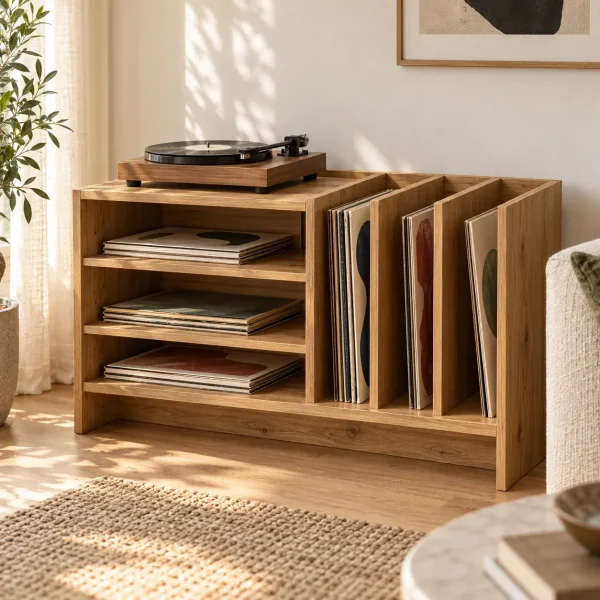
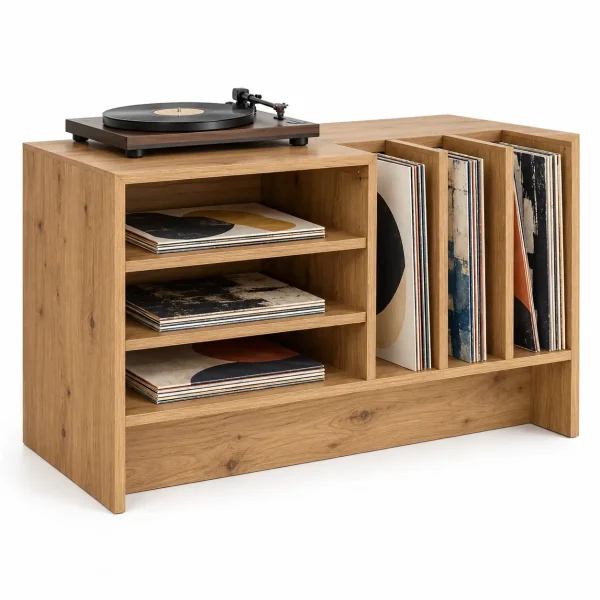
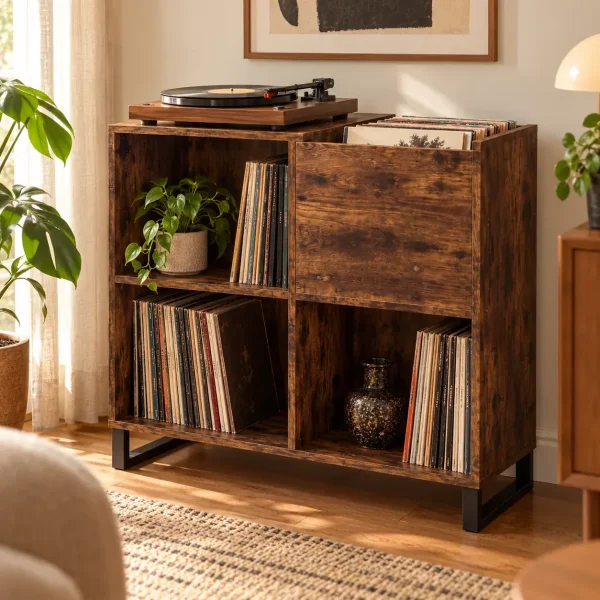
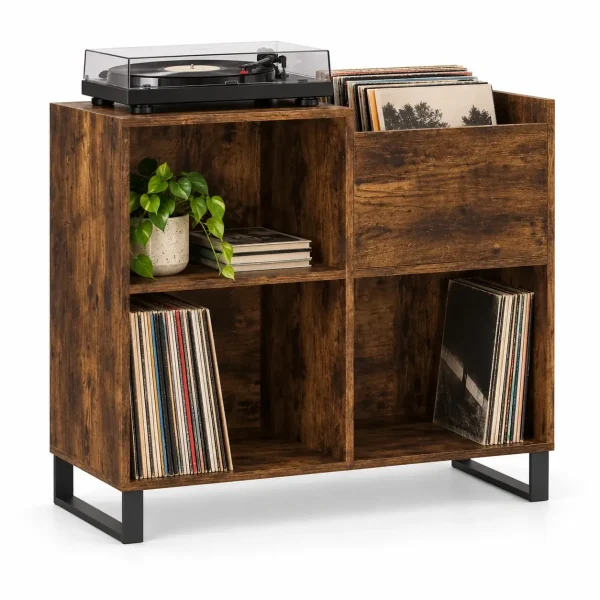
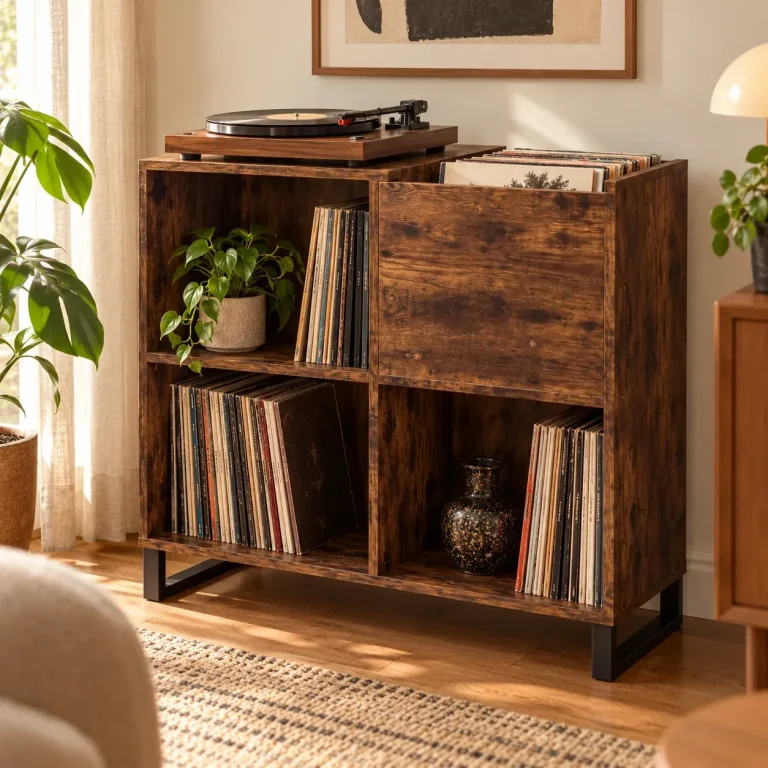
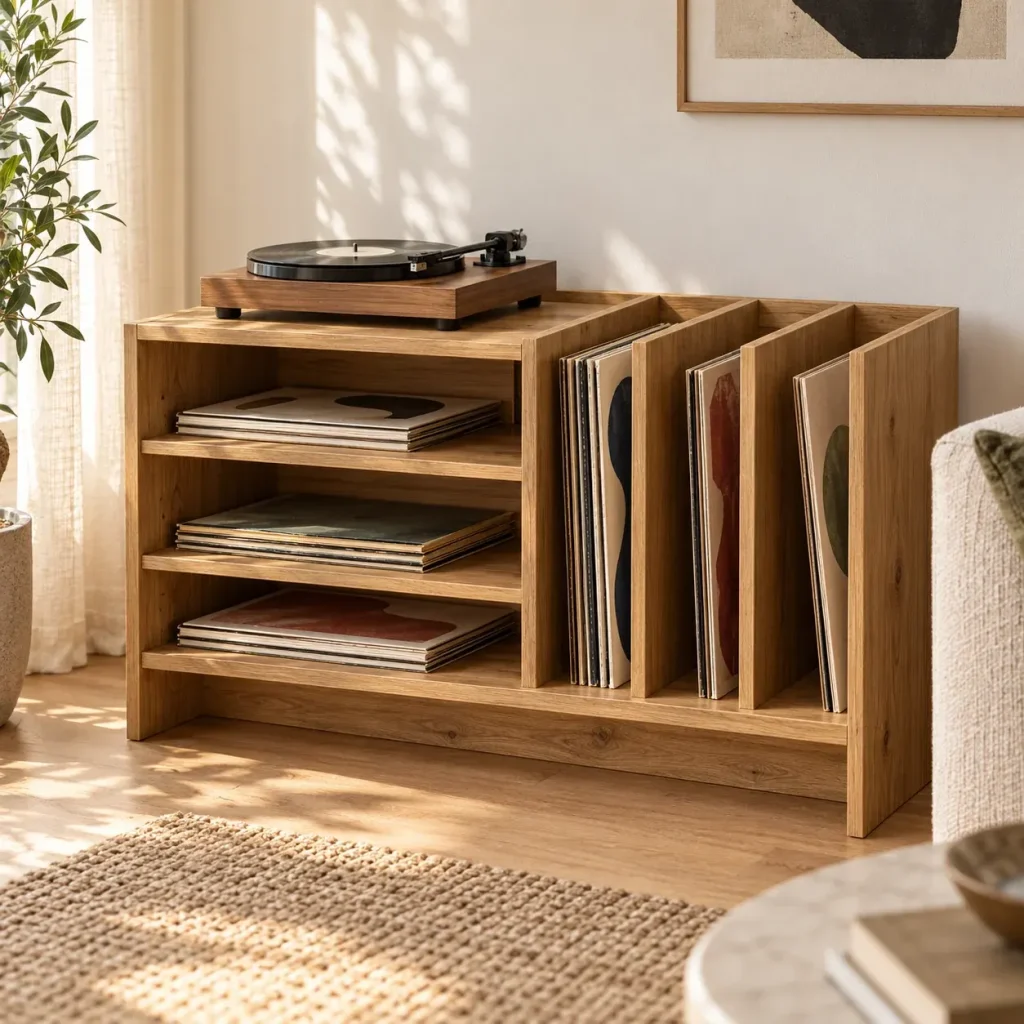
The stylus reads microscopic variations, so the slightest vibration is audible. Place the turntable on rigid furniture that does not move when someone walks past. Avoid putting it on the same surface as the speakers, whose vibrations travel up into the arm. A record player stand is designed for exactly this: a clear top for the turntable and compartments for records underneath.
A level turntable
A tilted platter makes the stylus sit crooked in the groove. Check it is level with a small spirit level placed on the platter, then adjust using the turntable’s adjustable feet if it has them, or shim the furniture.
The right height
Lowering the arm, flipping the record, cleaning it: you will handle the turntable every time you play something. A low unit such as Pigalle fits easily under a window or beside a sofa; a taller one such as Montmartre, at 89 cm, puts the turntable within easy reach. To compare dimensions, see our turntable size guide. If your set-up includes an amplifier, a hi-fi cabinet with a dedicated recess gives it its own place.
Frequently asked questions
Do I need a turntable with a built-in preamp?
No, only if your amplifier or speakers have no phono input. Otherwise, a turntable without a preamp plugs straight into the phono input.
Belt or direct drive for a beginner?
Both are fine for listening at home. A belt isolates the platter well from the motor; direct drive starts quickly and has no belt to replace.
Can I connect a turntable to a Bluetooth speaker?
Yes, if the turntable has Bluetooth. Otherwise, you need a speaker with a wired input and a phono preamp, either built in or external.
Where should I put my turntable?
On stable, level furniture, away from the speakers, out of direct sunlight and away from heat sources.