Before buying a frame, a crate or a cabinet for your records, one question always comes up: exactly how big is a vinyl record? The answer depends on the format, and above all on the sleeve, which is slightly larger than the disc. Here are the vinyl record sizes you need to know for LPs, 7″ singles and 10″ records, and what they mean for storage.
The three vinyl record formats
Vinyl records are usually described by their diameter in inches: 12″, 10″ and 7″. In centimetres, that is 30 cm, 25 cm and 17.5 cm (the exact figures are very slightly larger).
| Format | Record diameter | Most common use |
|---|---|---|
| 12 inches (30 cm) | approx. 30 cm | 33 rpm album (LP), 45 rpm 12″ single |
| 10 inches (25 cm) | approx. 25 cm | Older albums, mini-albums, special editions |
| 7 inches (17.5 cm) | approx. 17.5 cm | 45 rpm single, EP |
33 and 45: speed or size?
“33” and “45” refer to the rotation speed (33⅓ and 45 revolutions per minute), not the size. In everyday use, 33 is associated with the 30 cm album and 45 with the 17.5 cm single. But there are also 30 cm records cut at 45 rpm, the 12″ singles that are so common in electronic music. So before choosing storage, look at the diameter rather than the speed printed on the label.
The centre hole
An LP has a small centre hole of about 7 mm. Many 45s have a large hole of about 38 mm, which needs an adapter to play on a standard turntable.
Sleeve dimensions
It is the sleeve, not the record, that determines how much space you really need. It extends a few millimetres to roughly a centimetre and a half beyond the disc on each side.
- LP sleeve (12″): approx. 31.5 × 31.5 cm.
- 10″ sleeve: approx. 26 × 26 cm.
- 7″ single sleeve: approx. 18 × 18 cm.
A clear plastic outer sleeve adds a few more millimetres. These are the dimensions to keep in mind for a frame, a crate or a compartment.
Thickness: single sleeve, gatefold or box set
The width a collection takes up depends on the thickness of each record in its sleeve. It varies a great deal from one album to the next. The figures below are a rough guide.
Single sleeve
A standard record in a single sleeve is a few millimetres thick. Allow roughly 3 to 4 records per centimetre of compartment, a little fewer with heavyweight pressings.
Gatefold sleeve
A gatefold sleeve opens like a book. Thicker, it often holds two records and takes up noticeably more room than an album in a single sleeve.
Box set
A box set brings together several records, sometimes with a booklet, in a rigid box. It can be several centimetres thick, and is sometimes slightly larger than a standard sleeve. Give it a spot of its own, or leave some spare room in a compartment.
Measuring your collection yourself
Rather than counting your records, measure them. Stand your vinyl upright, packed normally, against a wall or in a box, and measure the total length with a tape measure. Do this by category if your collection mixes single sleeves, gatefolds and box sets. You get a real compartment width, far more reliable than an estimate based on an average. Also note the height of your largest formats: some box sets and special editions are bigger than a standard sleeve.
Record weight
A “180 g” pressing is thicker and heavier than a standard one. The difference is small for one record, but becomes noticeable across a hundred albums: a full compartment is heavy.
What these dimensions mean for a record cabinet
Compartment height and depth: 32 cm minimum
For an LP sleeve to stand upright without sticking out, a compartment needs at least 32 cm of internal height and depth. A few extra centimetres make records easier to pull out. That is why many standard bookcases are unsuitable: their shelves are often too shallow, and the sleeves stick out.
Mind the difference between external and internal dimensions: the thickness of the panels and back reduces the usable space. The dimensions given on our product pages are those of the unit itself. To compare easily, our size guide brings together the useful measurements.
Width: plan for tomorrow’s collection
Measure the width taken up by your current records, then add some margin for future purchases. Records packed too tightly get damaged when you pull them out; records too loose lean over. A divider helps keep them upright in a half-empty compartment.
7″ singles
In a compartment designed for LPs, 7″ singles get lost at the back. A dedicated box or small crate keeps them visible and together.
Which furniture should you choose?
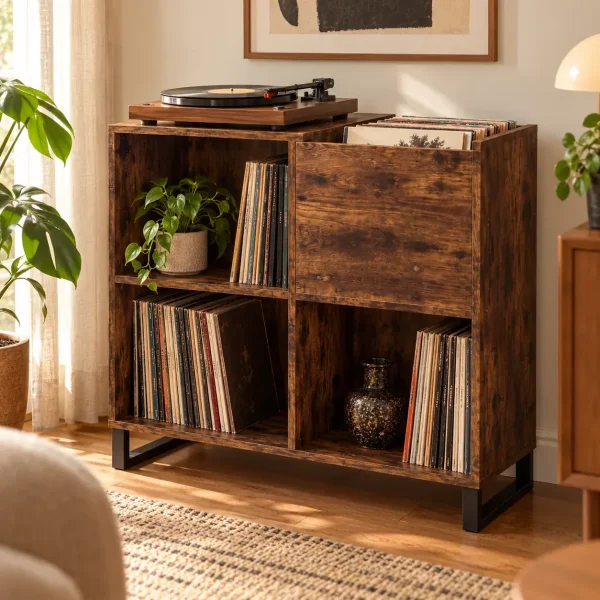
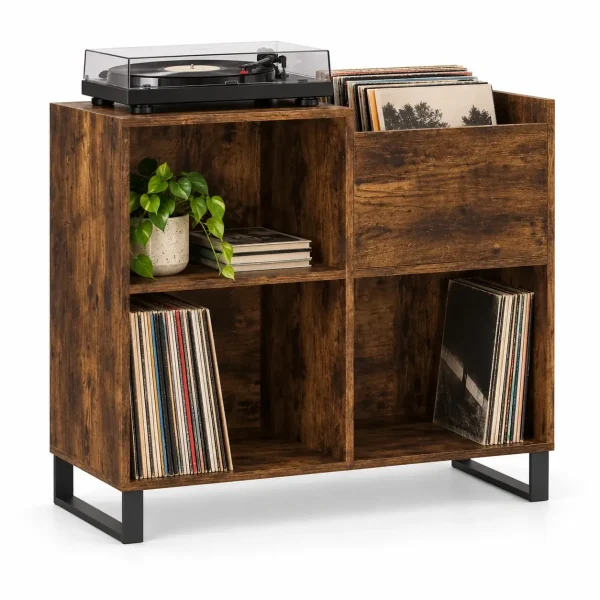
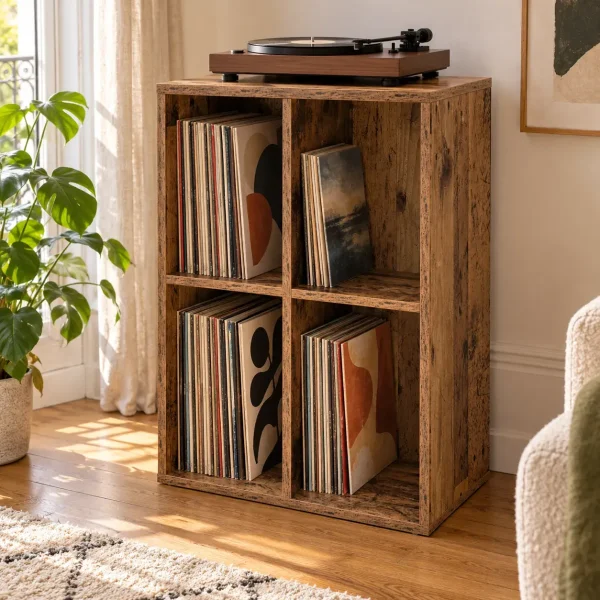
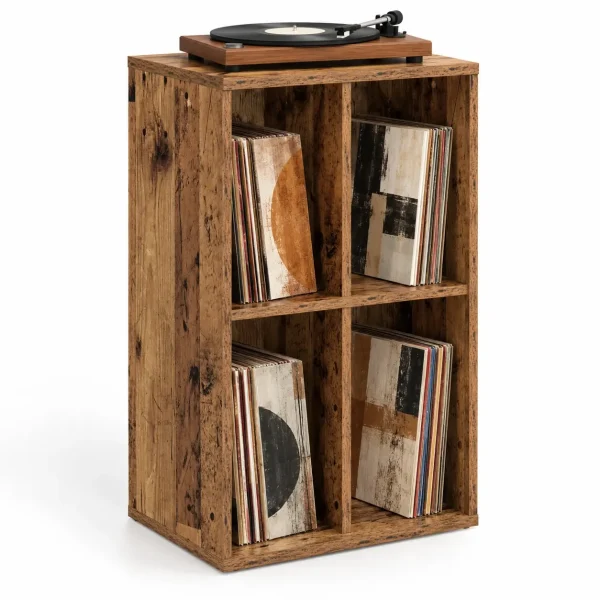
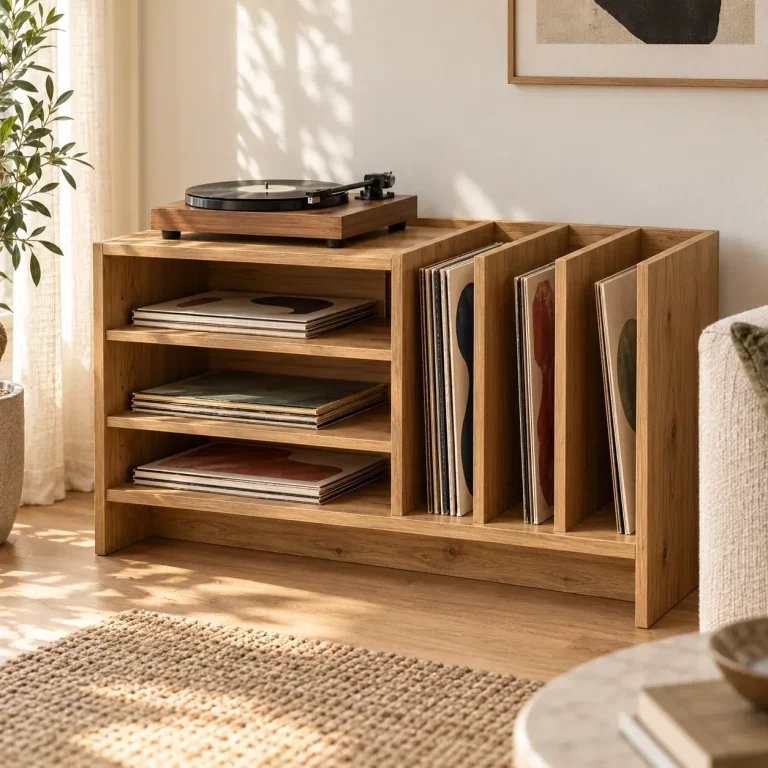
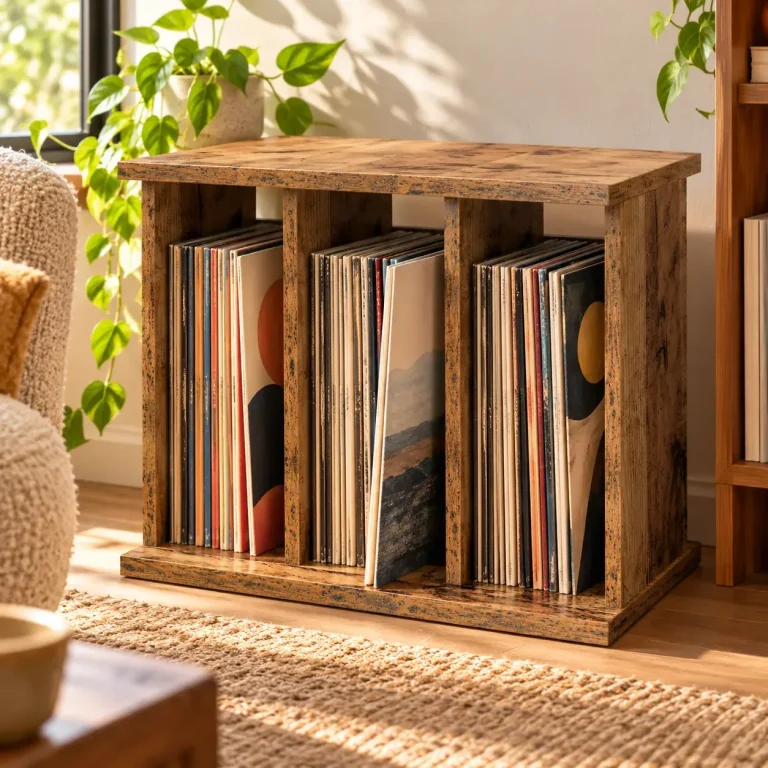
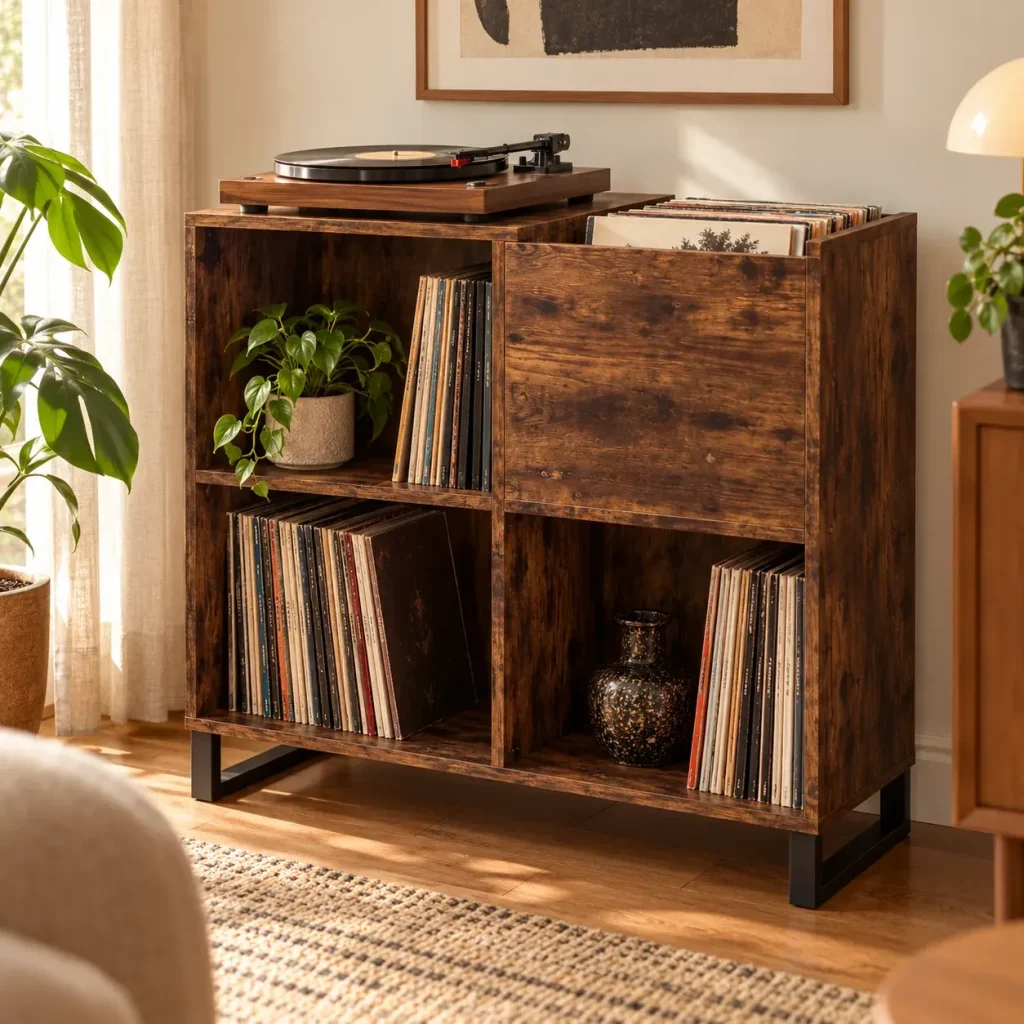
For a growing collection, a unit with large square compartments such as Montmartre, or the compact Clichy with 4 square cubes, holds albums upright. You can also browse our record shelves and our full range of vinyl record storage.
Frequently asked questions
What size is a vinyl LP?
The record is about 30 cm in diameter (12 inches). Its sleeve measures about 31.5 cm square.
What size is a 7″ single?
A classic 45 rpm single is about 17.5 cm in diameter (7 inches), with a sleeve of about 18 cm square. Some 30 cm records are also cut at 45 rpm.
How deep should a record shelf be?
Allow at least 32 cm of internal depth and height to store LPs upright without the sleeves sticking out.
How many records fit per metre of storage?
At 3 to 4 records per centimetre in single sleeves, one metre of compartment holds several hundred records. Gatefolds and box sets reduce that number considerably.