Listening to a record means giving yourself a break. You choose an album, put it on, sit down, and for twenty minutes you do nothing else. That ritual deserves a place of its own: a vinyl listening corner, however modest, where everything is within reach. You do not need a dedicated room. A few well-planned square metres are enough. Here is how to set one up, step by step.
Choosing the spot
One wall, two speakers, a seat
The ideal listening corner is organised around a wall, with the furniture and speakers on one side and the seating opposite. Look for a clear wall of at least 1.5 m to 2 m if you want to place the speakers either side of the cabinet, with enough space to sit facing them.
What to avoid
- Through traffic: a turntable near a door or a hallway is likely to get knocked, and every step on a springy wooden floor can make the stylus jump.
- Direct sunlight: it fades sleeves and heats records.
- Radiators: heat can warp a record.
- A tight corner: speakers placed in a corner boost the bass, sometimes too much.
In a small space
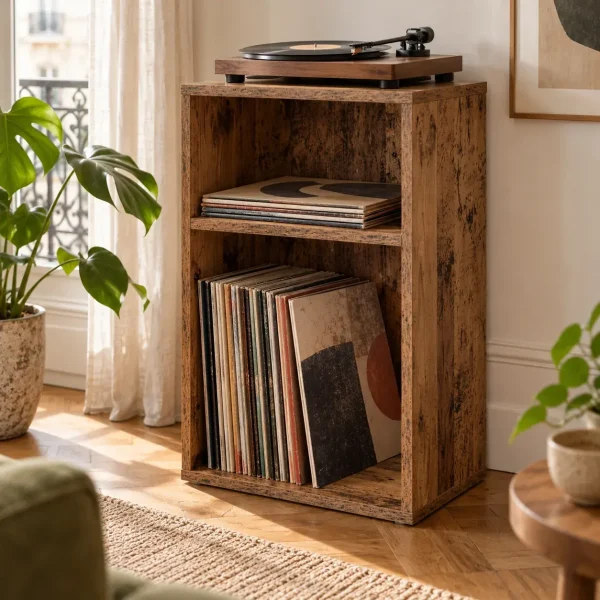
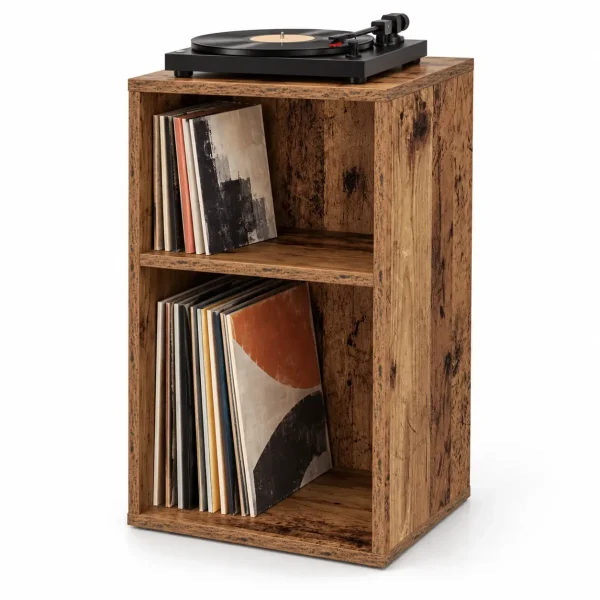
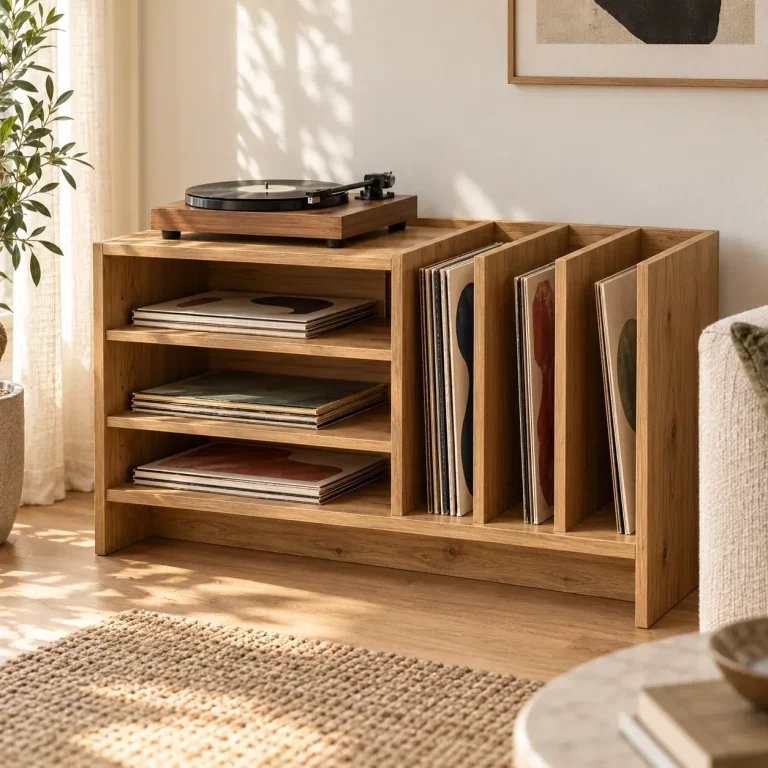
In a studio flat or a bedroom, a corner of wall or the space between two windows is enough. A small record cabinet 72 cm wide or less holds the turntable and a selection of records. Nation, 38 cm wide, was designed for a first listening corner.
The furniture: the heart of the listening corner
The furniture holds the turntable, stores the records and sometimes the amp. It is what gives the space its structure.
The technical criteria
- A stable, level top, large enough for the turntable, often around 45 × 35 cm.
- Clear height above to open the lid.
- Compartments at least 32 cm high and deep for LPs.
- An open, ventilated recess if you have a separate amp.
Low or tall?
A low unit, around 45 cm, goes well with listening seated on a sofa or armchair. A taller unit puts the turntable at hand height: practical if you change records often. To compare formats, browse our record player stands collection. If an amp is part of the set-up, look at a hi-fi cabinet instead.
Placing the turntable and speakers
A quiet spot for the turntable
Set the turntable up last, once the furniture is assembled and level. Check the turntable is level too, then adjust the arm according to the manufacturer’s instructions. Leave a few centimetres at the back for cables.
Speakers at a distance
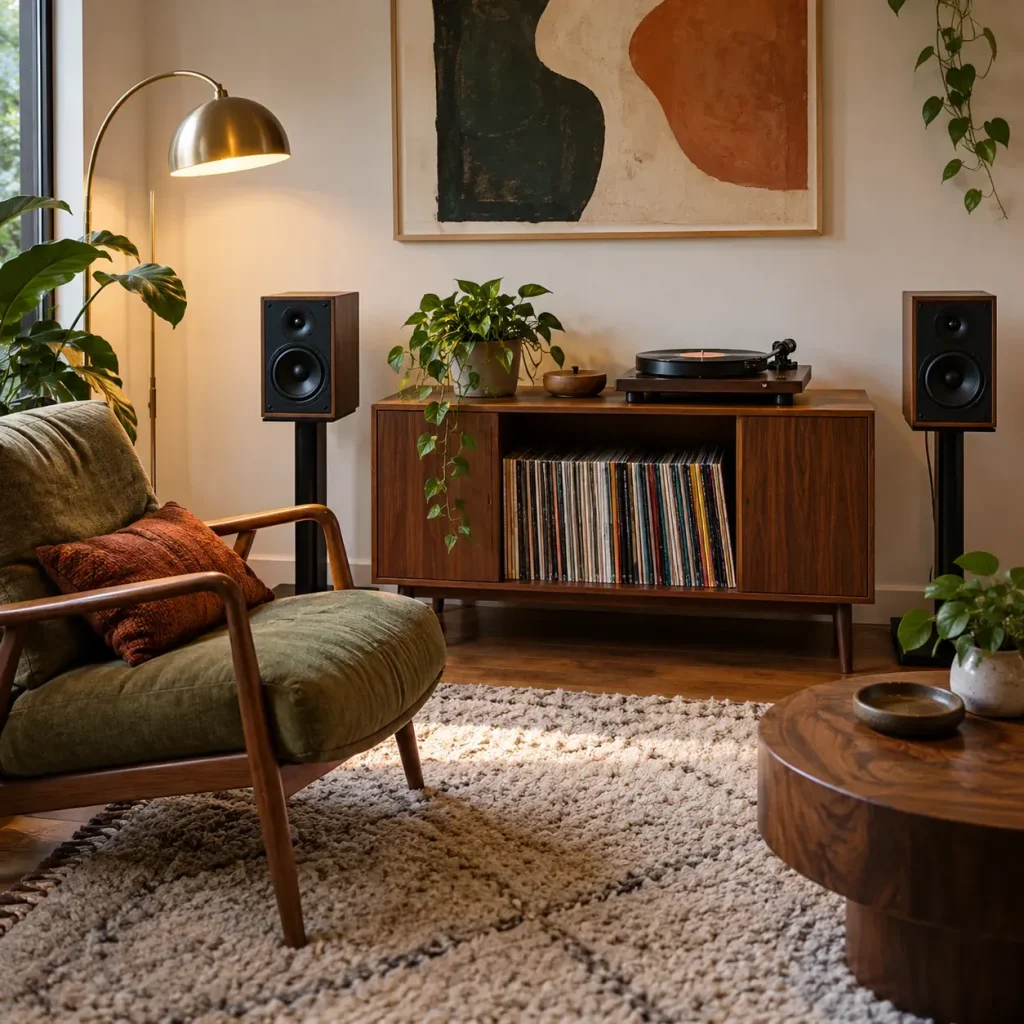
Keep the speakers away from the turntable: their vibrations can travel up to the stylus. The simplest option is to put them on stands either side of the cabinet, or on a separate surface.
The listening triangle
For a good stereo image, position yourself so that you and the two speakers form a roughly equal-sided triangle. Angle the speakers slightly towards your listening position. Move them a little away from the back wall to avoid excessive bass. Experiment: moving a speaker by just a few centimetres already changes the sound.
Keeping records within reach
A listening corner works when you do not have to get up three times to find a record.
- Your current favourites in the cabinet, just below the turntable.
- The rest of the collection on a shelf or in a crate alongside. See our vinyl record storage.
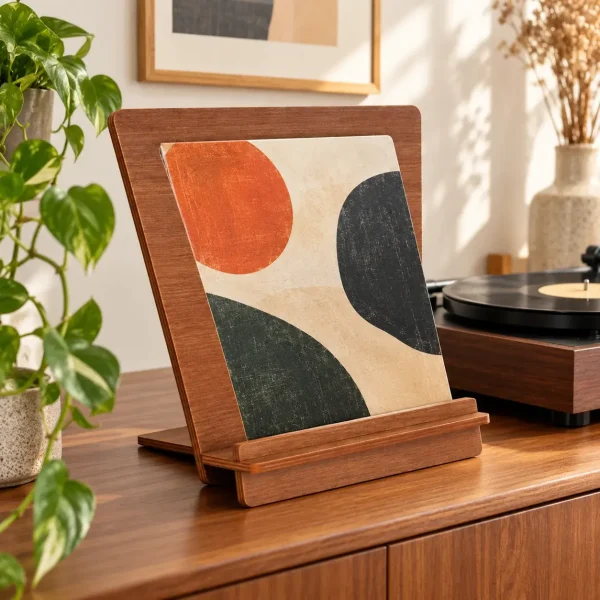
- The record you are playing displayed on a stand.
Always store records upright, without squeezing them. Allow roughly 1 cm of width for 3 to 4 records, depending on their weight, to estimate the space you need.
Seating
A comfortable armchair facing the speakers, a sofa, a few floor cushions: seating matters as much as the equipment. Place it at a distance from the speakers roughly equal to the gap between them. A small side table next to it holds the sleeve, a cup or a booklet.
Lighting
A lamp with soft, warm light, on a table or the floor, creates an atmosphere that suits evening listening. Avoid harsh overhead lighting. A little extra light above the turntable helps you drop the stylus in the right place. Some furniture has its own lighting built in, such as Saint-Ouen with its adjustable LEDs.
Decor
Sleeves as decoration
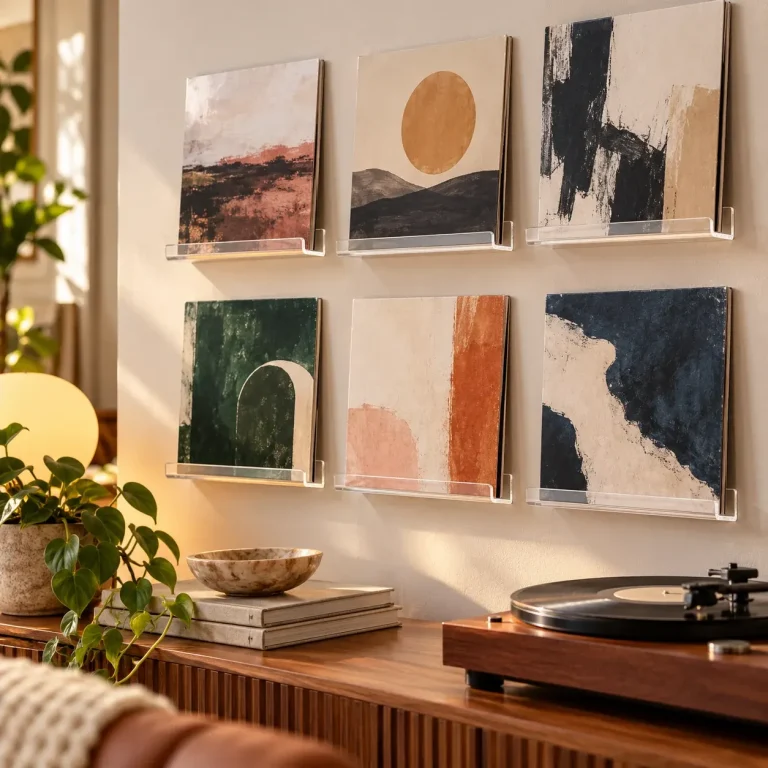
Record sleeves are often beautiful images. Display a few on the wall, in a row above the cabinet or in a grid. Our vinyl record wall holders let you change them as you listen.
“Now playing”
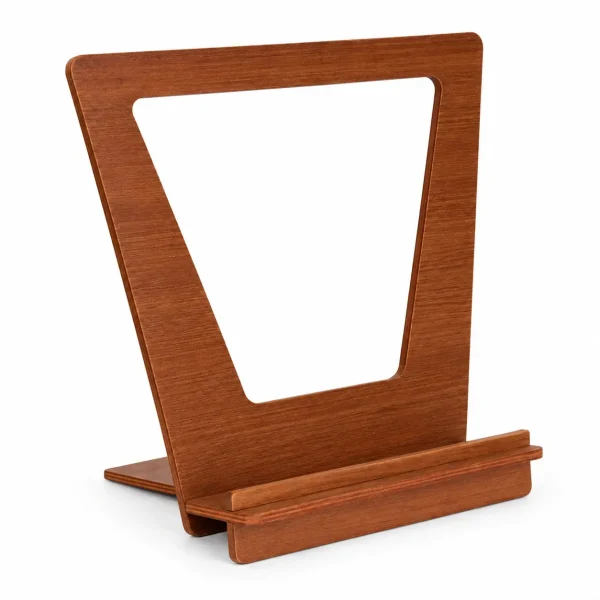
A stand placed next to the turntable shows off the sleeve of the record on the platter. Lepic, in wood, is a simple example. It is a small detail that brings the listening corner to life.
Materials
A rug under the seating reduces reverberation in the room and improves acoustic comfort. Heavy curtains, a full bookcase or a few plants do the same job. A room that is too bare often sounds hollow.
A listening corner for every interior
- Scandinavian: light oak furniture, white walls, linen, plants.
- Vintage: sideboard on splayed legs, dark wood, a brass lamp. See our vintage record cabinets.
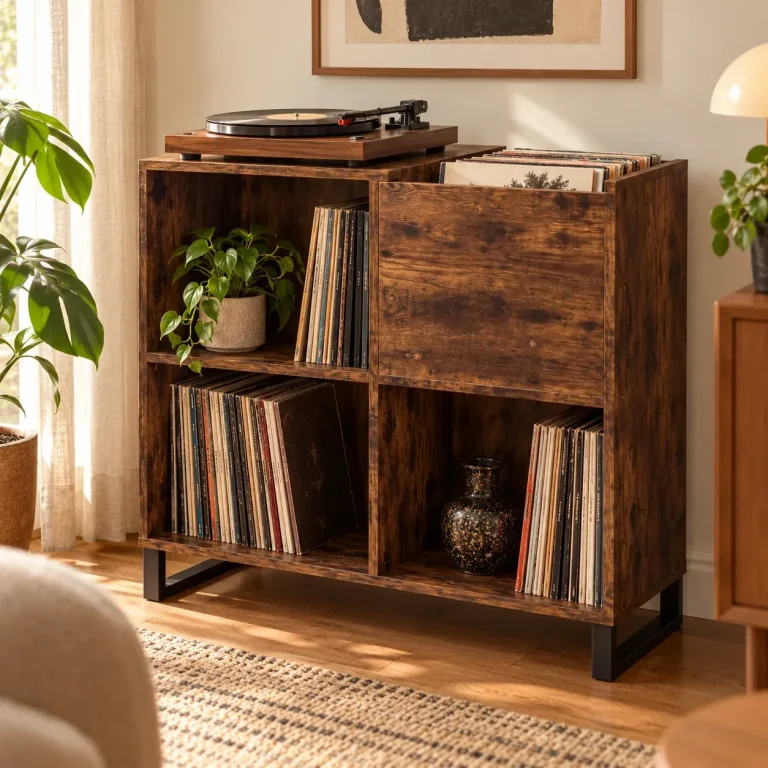
- Industrial: black metal, rustic wood, exposed brick.
- Contemporary: white, black or concrete grey, clean lines.
In summary
A good vinyl listening corner comes down to a quiet spot, stable furniture at the right height, speakers kept away from the turntable, records stored within reach and comfortable seating. The rest, lighting, sleeves on the wall, a display stand, is a matter of taste. Start small: one cabinet, one turntable, a handful of records. The listening corner will grow with the collection.