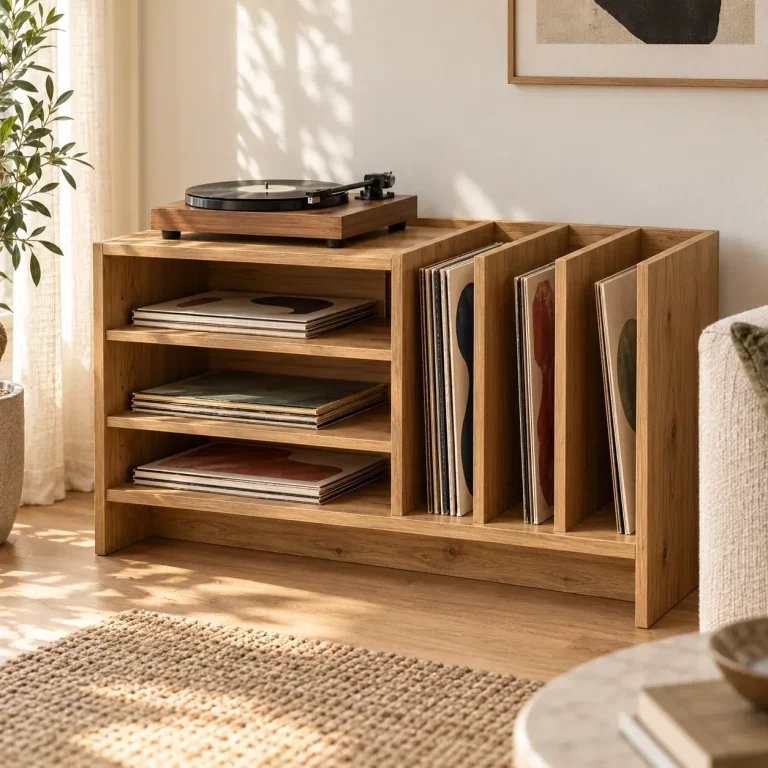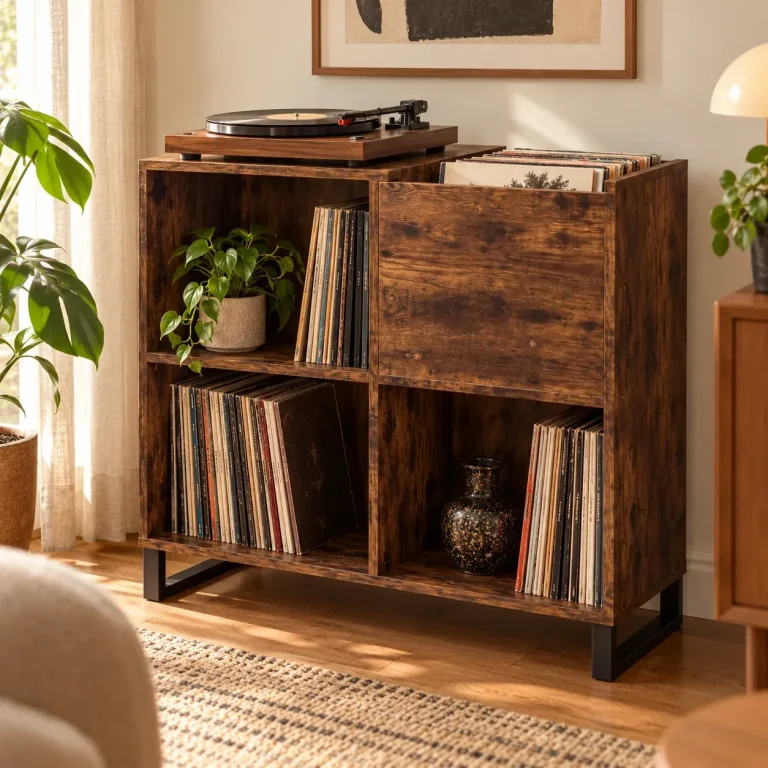
A vinyl collection often starts with a few records propped up next to the turntable. Then it grows, and storage becomes a pressing question. Knowing how to store vinyl records properly is not just about being tidy: it is what lets you play them for years, without warping or scratches, and find the record you are after in seconds. Here are the rules to know and the vinyl record storage solutions that suit every situation.
The golden rule: store vinyl records upright
A vinyl record is stored upright, vertically, like a book on a bookshelf. It is the most important rule, and the one most often broken.
Why not flat?
Stacked flat, the records at the bottom bear the weight of all those above. Over time, and especially in warm conditions, that pressure can warp the records or mark the sleeves. A stack also means lifting every record to reach the one at the bottom, which multiplies handling and the risk of dropping one.
Neither too tight nor too loose
Upright does not mean any old way. Records packed too tightly rub against each other and get damaged when you pull them out. Records too loose lean over and end up deforming. Ideally, they stand straight on their own, and you can pull one out without forcing it. If a compartment is not full, a divider or a bookend keeps them vertical.
The right dimensions for vinyl record storage
Sleeve size
An LP sleeve measures about 31.5 × 31.5 cm. A compartment or shelf therefore needs at least 32 cm of height and depth so the sleeves do not stick out. This is where many standard bookcases fall short: they are often too shallow. Smaller 7″ singles measure about 18 cm square in their sleeve.
Estimating capacity
To work out how many records will fit in a compartment, allow roughly 1 cm of width for 3 to 4 records. It is only an estimate: a 180 g pressing, a gatefold sleeve or a double album takes up more room than a standard record in a single sleeve. A compartment 30 cm wide will therefore hold several dozen records. Where we know a unit’s exact capacity, we give it on the product page.
Think about weight
A hundred or so records are heavy. Before filling a shelf, check its maximum load where one is given, and spread the records over several levels. Put the heaviest at the bottom.
Which storage should you choose?
There is no single right way to store records, but there are solutions to suit the size of your collection and the way you listen.
The record cabinet with compartments
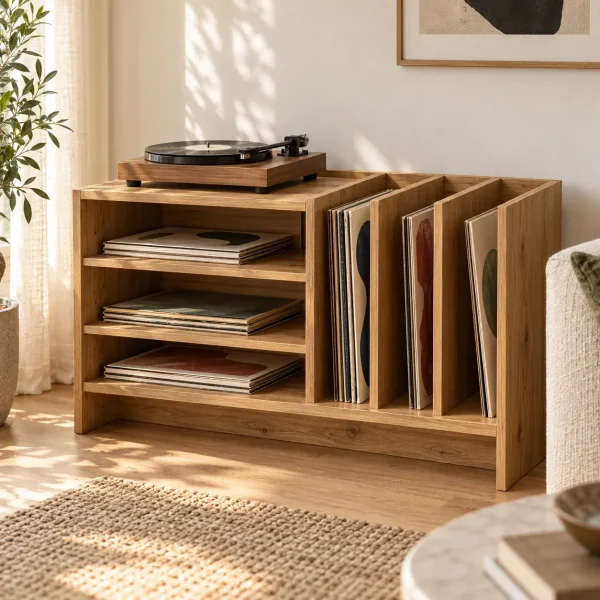
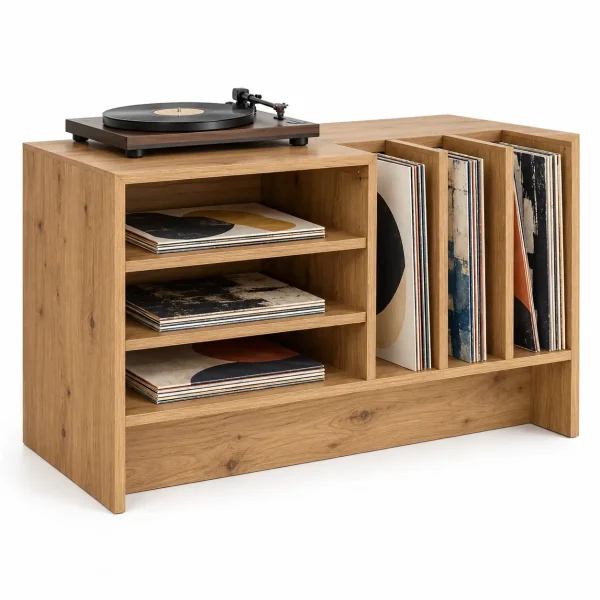
The most complete solution: the turntable on top, the records below. A model such as Pigalle combines shelves and 4 vertical compartments across 78.5 cm of width. Our full selection is gathered in the record cabinets collection.
The record-shop crate
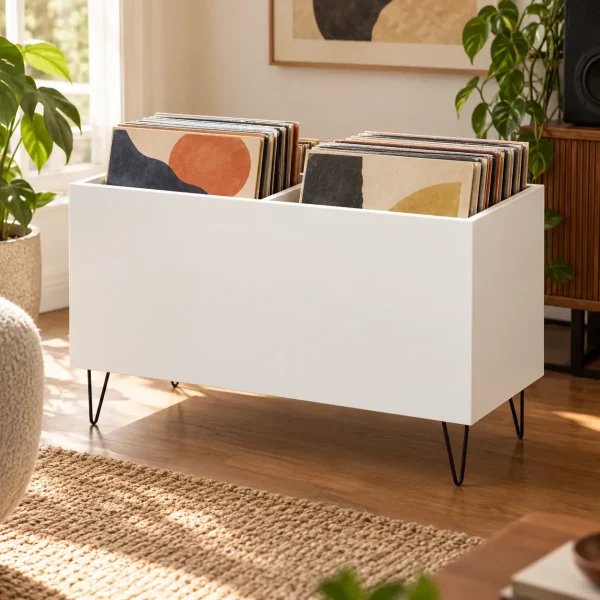
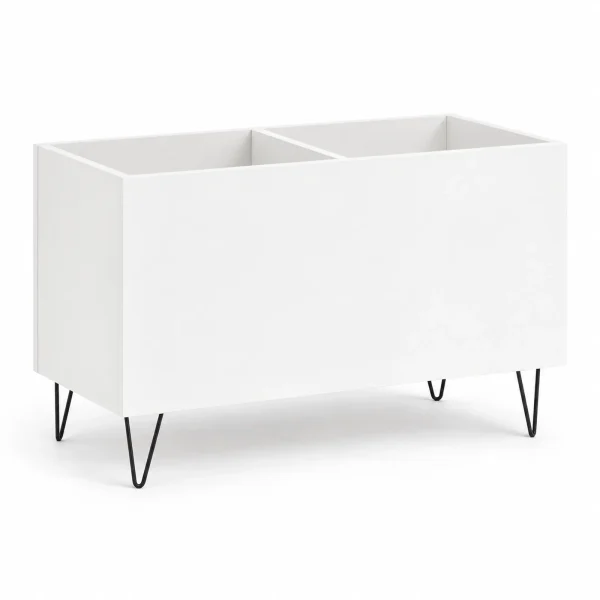
You flip through records from above, front cover visible, just like in a record shop. It is ideal for the records you play most. Mouffetard takes up this idea on hairpin legs. More models in our vinyl record crates selection.
Shelves or cubes
For a large collection, going up saves floor space. Square cubes separate records by genre or era. See our record shelves.
Small storage
For a first selection or the records of the moment, a crate or a tabletop holder is enough. Pantin, in bamboo, holds up to 50 LPs, for example.
Protecting your records
Inner and outer sleeves
The inner sleeve protects the record’s surface from dust and micro-scratches. Original paper inner sleeves can shed fibres; many collectors replace them with anti-static ones. The clear outer sleeve protects the cardboard from wear and rubbing.
Heat, light, humidity
- Heat can warp a record: never near a radiator or on a sunny windowsill.
- Direct sunlight fades sleeves.
- Humidity encourages mould on cardboard: avoid cellars and poorly ventilated rooms.
A living space at a moderate temperature, out of direct sunlight, is ideal.
Good habits
Hold the record by its edge and the centre label, never by the grooved surface. Put it back in its inner sleeve straight after playing, then store it right away: a record left out of its sleeve gathers dust.
Organising your collection
There is no universal method, only the one that helps you find your records.
- Alphabetically by artist: the simplest for a large collection.
- By genre, then by artist: handy when you choose according to mood.
- Chronologically: to follow the development of an artist or an era.
- In order of purchase: more personal, less practical as the collection grows.
A tip: keep a small selection of the records you are currently playing separately, near the turntable. A now playing record stand can hold the sleeve of the record on the platter.
Mistakes to avoid
- Stacking records flat, even temporarily.
- Choosing a shelf that is too shallow, with sleeves sticking out.
- Filling a compartment so full you have to force a record out.
- Storing records near a heat source or in the sun.
- Leaving a record out of its sleeve after playing.
- Forgetting to leave room for future purchases.
In summary
Store your vinyl records upright, in compartments at least 32 cm high and deep, without squeezing them, away from heat and light. Allow roughly 3 to 4 records per centimetre to estimate capacity, and choose the format, cabinet, crate or shelf, to suit the size of your collection. To go further, browse our full range of vinyl record storage.