A Bluetooth turntable plays your records like any other turntable, then sends the sound wirelessly to a speaker or headphones. No more cable running across the room: that is often what wins over newcomers to vinyl. You still need to understand what happens between the groove and the speaker, know when Bluetooth is enough and when a cable is still better, and choose the right place to put it. Here are the essentials.
How a Bluetooth turntable works
The start of the chain does not change. The stylus follows the groove, and the cartridge turns its vibrations into a very weak electrical signal. That signal then goes through a phono preamplifier, built into the turntable, which brings it up to the level of an ordinary source. Only at this point does the Bluetooth transmitter come into play.
From groove to wireless signal
The transmitter converts the analogue sound into digital data, compresses it and sends it by radio waves to the paired device: Bluetooth speaker, wireless headphones or soundbar. The sound you hear has therefore been digitised along the way. The record itself is still played in an entirely mechanical way.
Pairing
The first time, you need to pair the two devices: put the turntable into pairing mode, then the speaker or headphones, and they recognise each other. After that, the connection is usually restored automatically when you switch on. Depending on the model, the turntable may only connect to one device at a time: check its manual if you plan to switch often between headphones and a speaker.
Bluetooth or cable: a turntable’s two outputs
Most Bluetooth turntables keep a wired output, usually two RCA sockets (red and white) on the back. This lets you connect the turntable to an amplifier or active speakers, bypassing wireless compression.
The phono / line switch
A turntable with a built-in preamp often has a small switch near the RCA sockets:
- Line position (LINE): the preamp is on. Connect the turntable to an ordinary input (AUX, LINE, CD) on an amp or to active speakers.
- Phono position (PHONO): the preamp is bypassed. Connect the turntable to an amp’s PHONO input or to a separate phono preamp.
Bluetooth, however, always goes through the built-in preamp. If there is no wireless sound even though the connection is established, check the position of this switch and the speaker’s volume setting.
When to choose the cable
For focused listening on a good pair of speakers, a wired connection keeps the signal analogue from end to end. Bluetooth is ideal for listening on headphones without being tied to the cabinet, for a speaker placed in another part of the room, or for getting started simply with the equipment you already have.
Sound quality and latency: what you need to know
The quality of a Bluetooth link depends on the codec, meaning the compression method used. The turntable and the speaker must share the same codec: if they do not, they fall back on the basic codec, which is more compressed. If fidelity matters to you, check the codecs listed for both devices before buying.
Latency is the slight delay between playback and the sound you hear. When listening to a record it goes unnoticed: there is no picture to give the delay away. You mainly notice it if you watch the arm as the stylus drops.
Finally, range decreases with walls, furniture and other wireless devices. For a stable connection, keep the speaker or headphones in the same room as the turntable and avoid hiding the turntable behind a door or in a closed unit.
Where to put a Bluetooth turntable
Wireless gets rid of cables, not the laws of mechanics. The stylus reads a microscopic groove: the slightest vibration in the surface beneath it is audible, however the sound is transmitted.
Stable, level furniture
Choose furniture that does not move when touched and sits perfectly flat. A tilted platter pushes the arm against one side of the groove and wears the record unevenly. A small spirit level placed on the platter is enough to check; most turntables have adjustable feet to correct a slight difference.
Away from vibrations
Avoid putting the turntable on the same furniture as the speaker: at high volume, the bass travels into the platter and back into the groove. That is precisely one of Bluetooth’s advantages: the speaker can go further away, on a shelf or another piece of furniture. Also keep the turntable away from a washing machine, a floor that resonates when people walk over it or a door that gets slammed.
At the right height
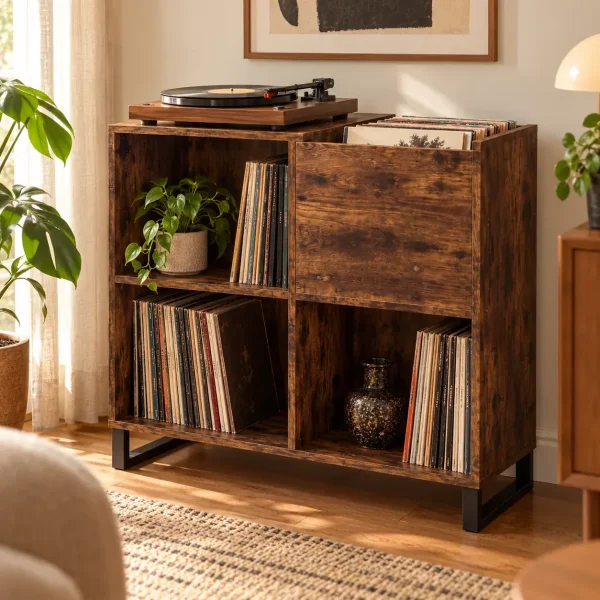
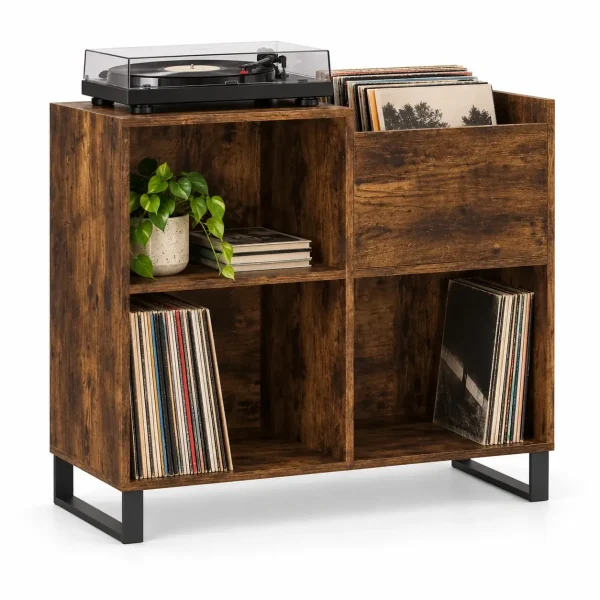
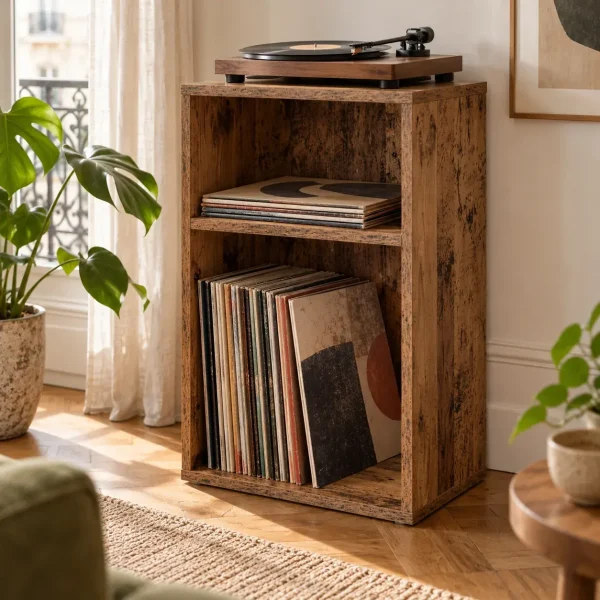
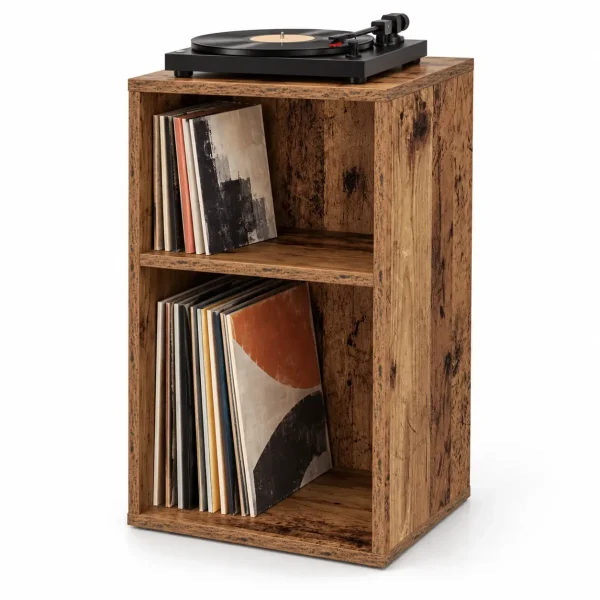
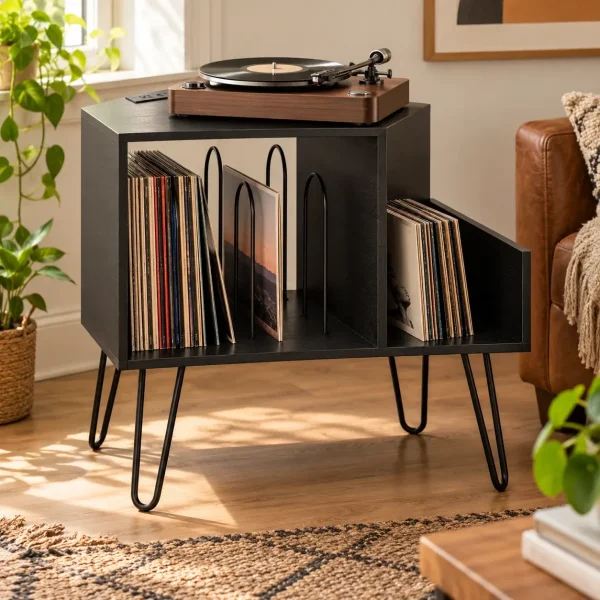
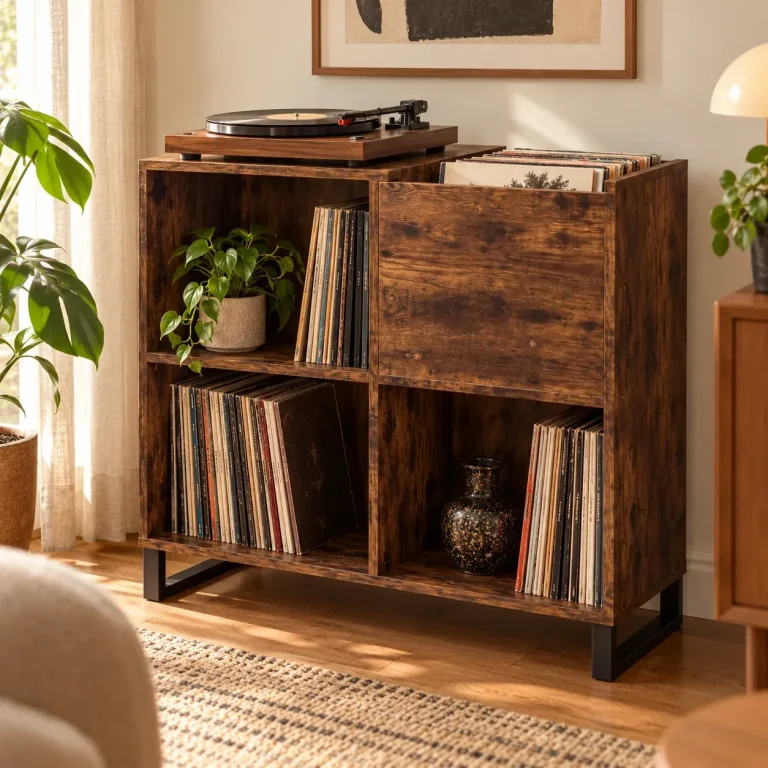
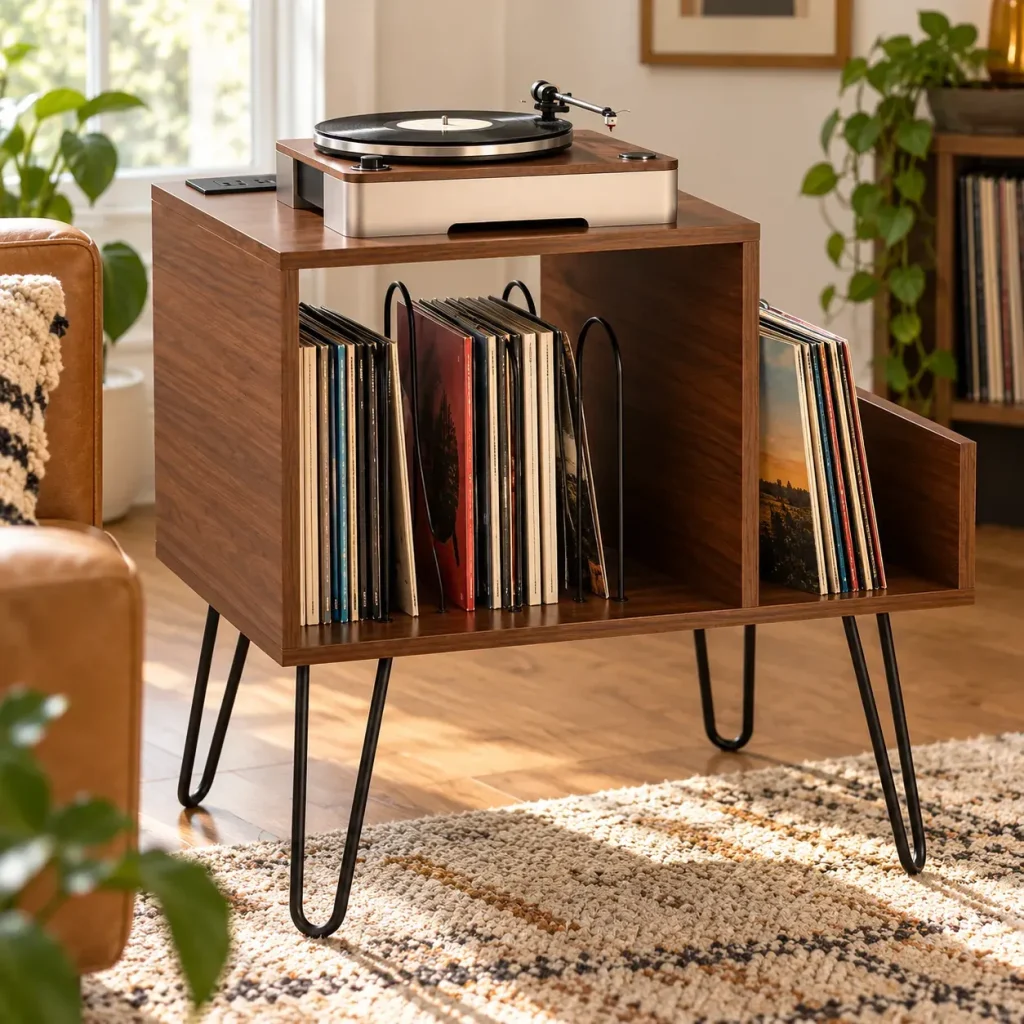
You handle a turntable standing up: placing the record, lowering the arm, flipping the side. A top at hand height makes these movements safer and saves you leaning over the arm. A tall unit such as Montmartre (89 cm) puts the turntable at that height, with four large compartments for records underneath. For a first listening corner in a small space, Nation brings together the turntable and your first records in just 38 cm of width.
Enough room around it
Measure the width and depth of the turntable and compare them with the top of the unit. Think about the lid: when open, it needs clear height above. So the turntable does not go in a closed recess, but on top of the furniture.
Organising a wireless listening corner
A Bluetooth turntable cuts cables down to almost nothing: a power lead, sometimes an RCA cable. Make the most of it to keep the furniture tidy.
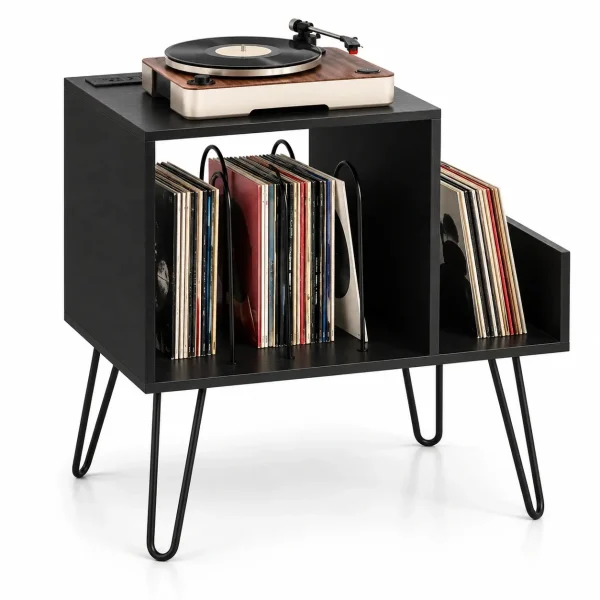
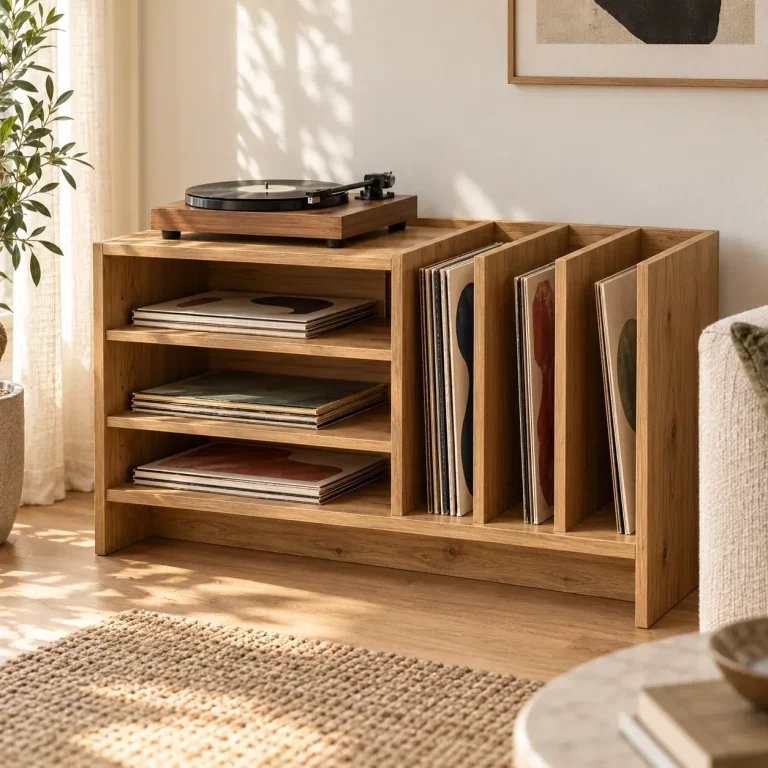
- Records beneath the turntable, upright in compartments, so they are within easy reach. Our selection of record player stands combines a top with storage.
- A socket nearby for the turntable and for charging the headphones or speaker. The Rivoli unit has a built-in charging station with sockets and USB ports, handy for wireless headphones.
- The speaker on a separate surface: a shelf, a neighbouring unit or a stand, at ear height if possible.
If space is tight, browse our small record cabinets; if the collection grows faster than expected, extra vinyl record storage can take over.
Frequently asked questions
Does a Bluetooth turntable need an amplifier?
Not for wireless listening: the Bluetooth speaker or headphones have their own amplification. An amp is only useful if you use the RCA output with passive speakers.
Can I connect a Bluetooth turntable to a hi-fi system?
Yes, via its RCA output. Set the switch to LINE for an AUX or CD input, or to PHONO for a phono input.
Does Bluetooth spoil the sound of vinyl?
It digitises and compresses it, which takes away some of the detail. How much depends on the codec and the speaker; for demanding listening, choose a wired connection.
Can I put the Bluetooth speaker next to the turntable?
Best avoided: bass vibrations travel up to the stylus. Put it on another piece of furniture or a shelf.