The amplifier is the heart of a classic vinyl system: it receives the signal from the turntable, brings it up to level and drives the passive speakers. Choosing the right one mostly comes down to checking three things: that it can take a turntable, that it suits your speakers and that it will fit in your furniture. Here is how to choose a turntable amplifier, then connect and install it without mistakes.
The amplifier’s role in a vinyl system
Between the turntable and the speakers, the signal goes through two stages. The phono preamp boosts the cartridge’s very weak signal and corrects its balance according to the RIAA curve. The amplifier then gives that signal the power needed to move the drivers. An integrated amplifier, the most common component in hi-fi, combines source selection, volume and power amplification in a single box. Some also include a phono preamp.
Phono input: the first criterion
On the back of an amp, look for an input marked PHONO. It contains a phono preamp, so you can plug in a turntable without a built-in preamp directly.
- Amp with a phono input: any turntable will connect. If yours has a built-in preamp, set its switch to PHONO to bypass it.
- Amp without a phono input: you need a turntable with a built-in preamp (switch set to LINE) or an external phono preamp, connected to an AUX, LINE or CD input.
Watch out for home cinema receivers and some recent streaming-focused amps: many have no phono input. It is not a deal-breaker, but plan for a preamp.
Moving coil cartridges
A phono input is usually designed for moving magnet (MM) cartridges, the most widespread type. Moving coil (MC) cartridges produce a weaker signal: they need an MC-compatible input, often indicated by an MM / MC switch, or a suitable preamp.
How much power do you need?
An amp’s power, given in watts per channel, is often put front and centre, but it does not tell the whole story. What matters is the match between the amp, the speakers and the room.
Check the speaker specs
- Sensitivity (in dB): a sensitive speaker plays loud with little power; a less sensitive one needs more for the same volume.
- Impedance (in ohms, often 4, 6 or 8): make sure the amp can handle your speakers’ impedance. The amp’s manual will tell you.
- Power handling: the range recommended by the speaker manufacturer is a good guide when choosing the amp.
A cautious rule of thumb
In an ordinary-sized living room, with typical bookshelf speakers, a few tens of watts per channel are generally enough for comfortable listening. A large room, low-sensitivity speakers or a liking for loud volume justify more. An amp slightly more powerful than you need is not a problem: it works with more headroom. An underpowered amp pushed flat out will clip and can strain the speakers.
Connecting the amp and turntable
- Switch everything off before connecting anything.
- Turntable to amp: RCA cable from the turntable to the PHONO input (or line input, depending on your set-up). Red for the right channel, white for the left.
- Ground wire: screw it to the amp’s GND terminal. Without it, a low hum is common.
- Speakers: speaker cable from the amp’s terminals to each speaker, respecting polarity, + to + and − to −. Reversing it on just one speaker gives a hollow sound with no bass.
- Powering up: turntable first, amp last, volume at minimum, input selected.
Cables
- Keep the RCA cables between turntable and amp short: the phono signal is fragile.
- Use speaker cables of the same length on both sides.
- Keep signal cables away from power cables as far as possible, and do not coil them together.
- Leave a little slack behind the furniture so you can slide the amp out without unplugging everything.
Installing the amp in a cabinet: ventilation
An amplifier gets warm, sometimes very warm. It releases that heat through the vents in its top and sides. Shut in without airflow, it overheats, may go into protection mode and ages faster.
The rules to follow
- An open recess rather than a compartment closed with a door. If the recess has a back panel, leave space behind the amp so air can circulate and cables can pass.
- Space above: measure the amp’s height and compare it with the recess, keeping several centimetres to spare. The manual often states a minimum clearance: follow it.
- Nothing on top: no turntable, no records, nothing that would cover the vents.
- Records at a distance: heat can warp records. Keep them in compartments away from the amp.
Why not put the turntable on the amp
As well as heat, an amp gives off slight vibrations and an electromagnetic field around its transformer. Underneath a turntable, it can cause a hum. The turntable belongs on the top of the cabinet, with the amp in a recess below or alongside.
Furniture designed around the amp
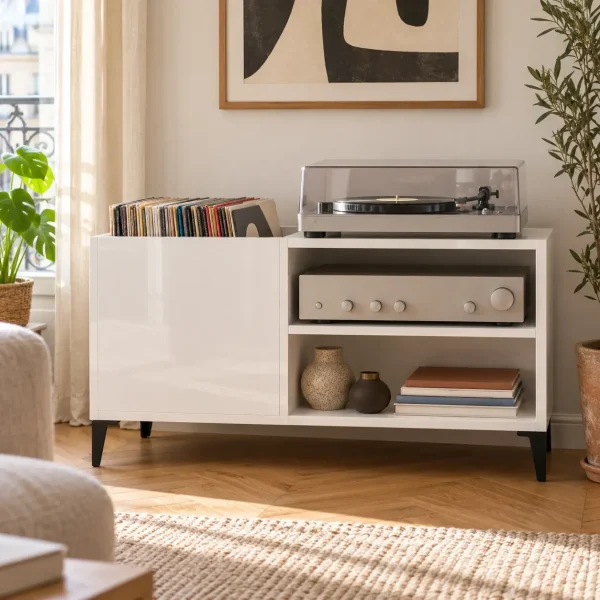
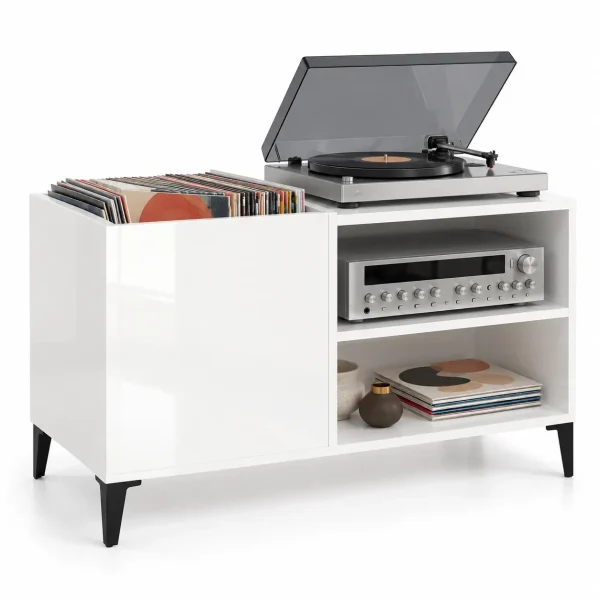
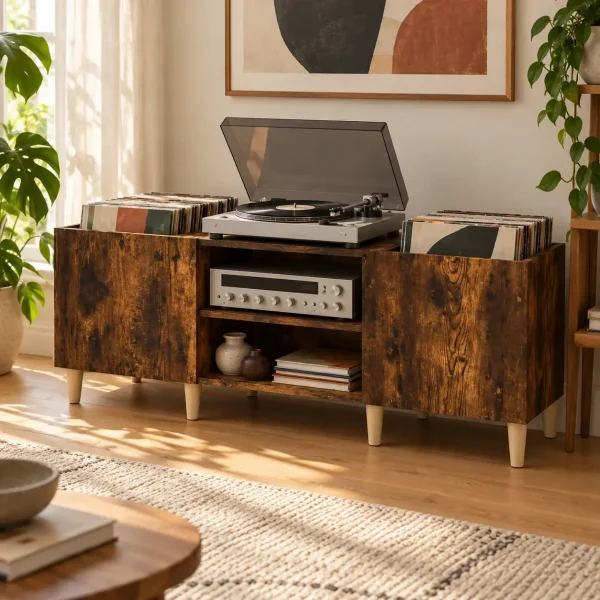
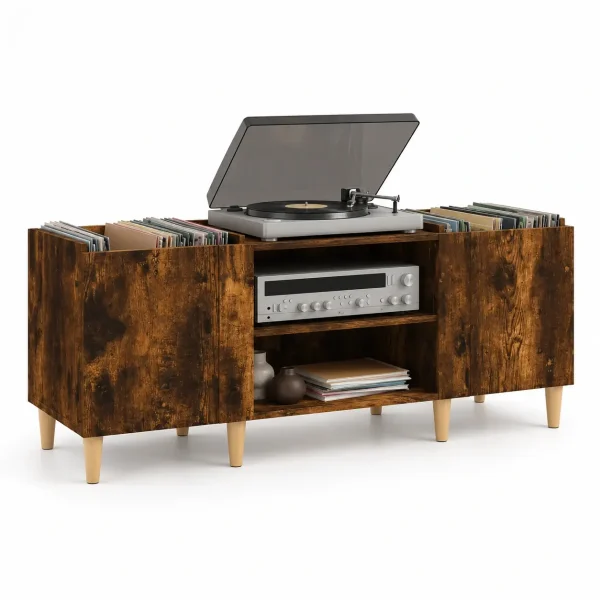
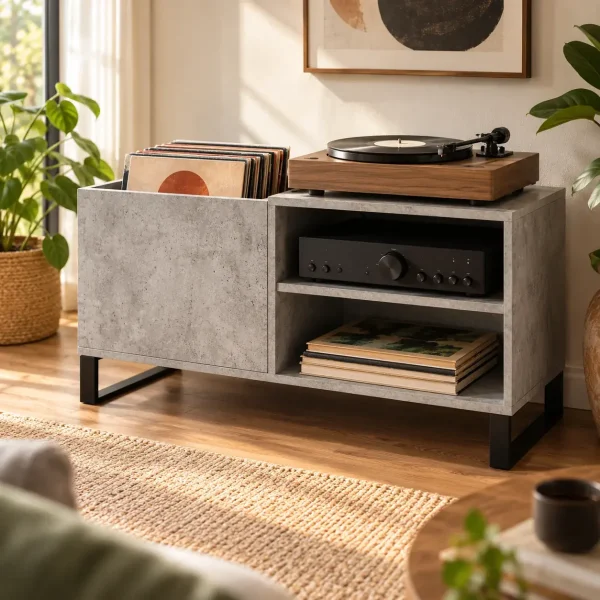
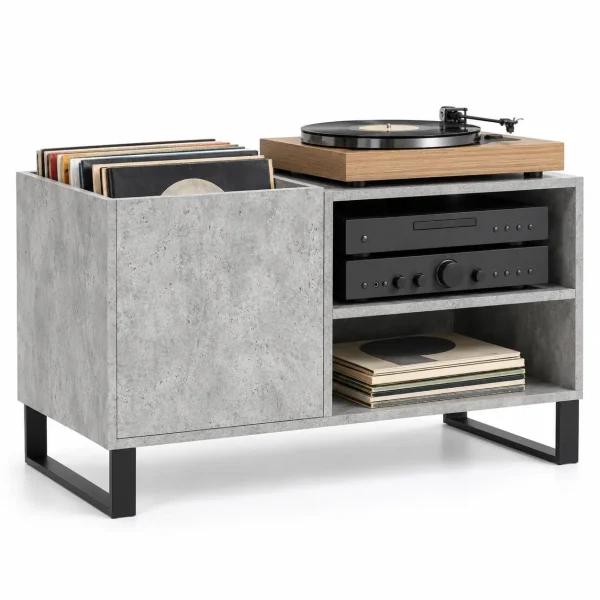
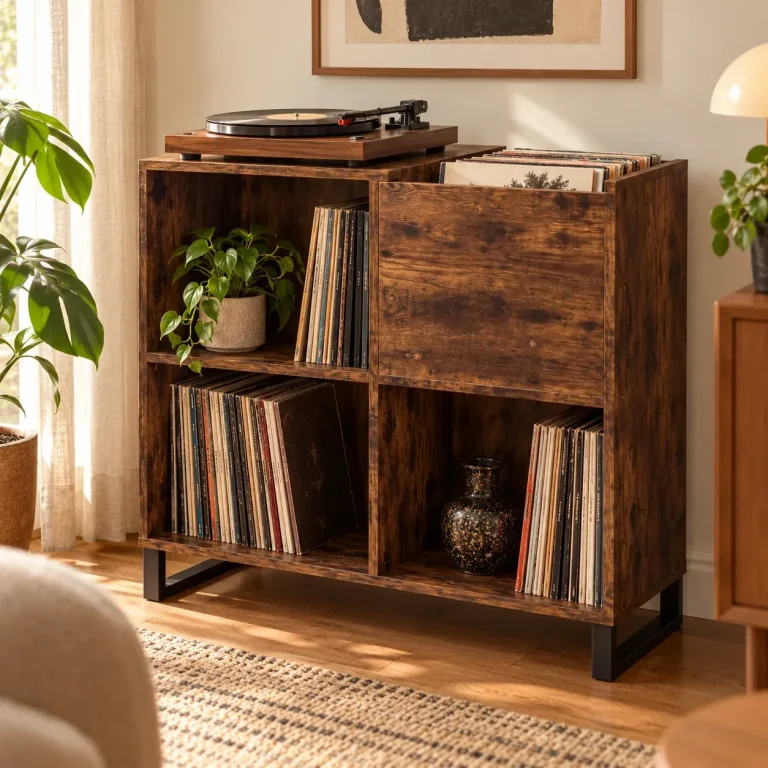
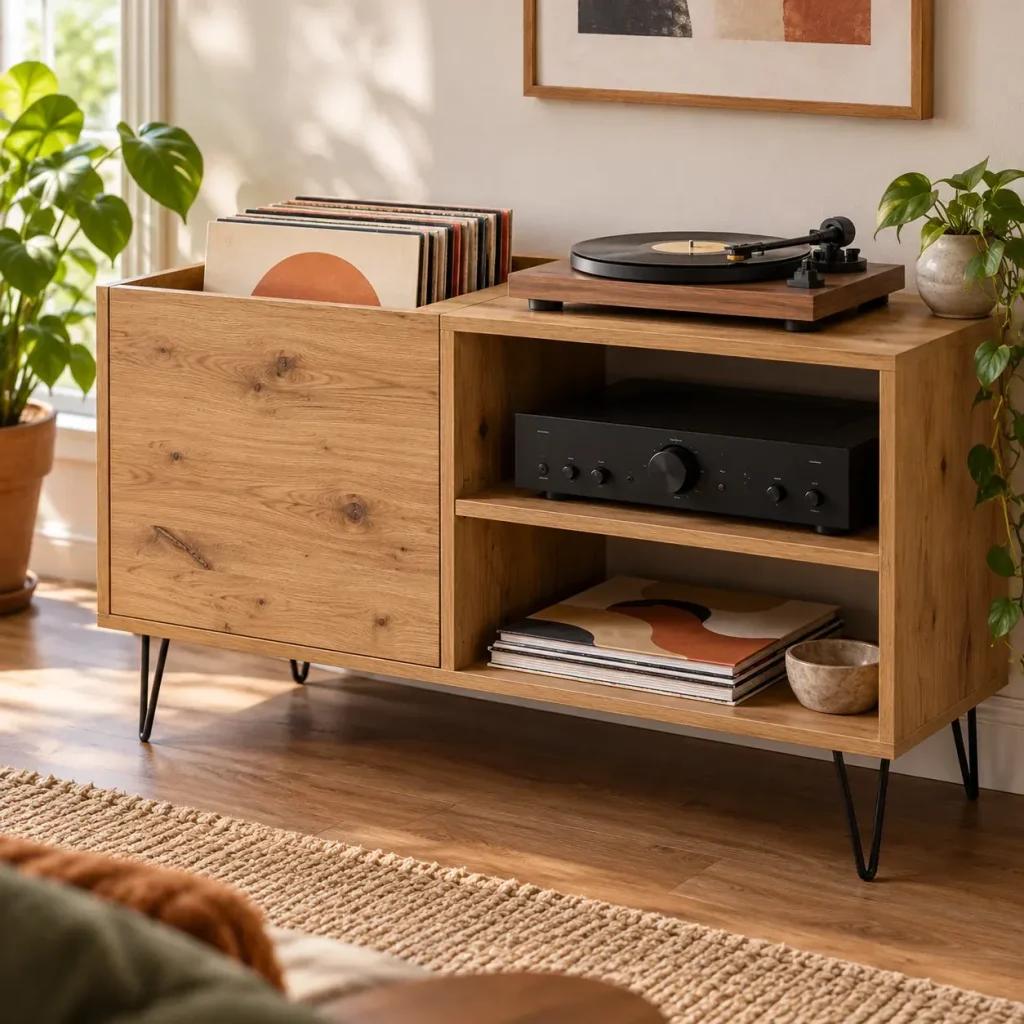
Our hi-fi cabinets provide one or more open recesses for the amplifier, beneath the turntable top.
- Batignolles (84.5 cm): a large record compartment behind a door on the left, two open recesses for the amp on the right. The records stay protected, the amp can breathe.
- Bastille (121 cm): two side doors for records and central recesses for the amp, with enough length to keep the speakers away from the turntable.
- Belleville (85 cm): one closed compartment and two open recesses, one for the amp and one for a preamp or another source.
To house a television or large speakers as well, see our TV and hi-fi units. Before ordering, compare your amp’s dimensions with those of the recesses given on each product page.
Frequently asked questions
Can I connect a turntable to any amplifier?
Yes, provided there is a phono preamp in the chain: in the amp (PHONO input), in the turntable or in a separate box.
How many watts does a turntable amplifier need?
It depends mainly on the speakers’ sensitivity and the room. For an ordinary living room and typical bookshelf speakers, a few tens of watts per channel are generally enough.
Can I put an amplifier in a closed cabinet?
It is not recommended. Choose an open recess, with space above and behind the unit.
My home cinema receiver has no phono input: what should I do?
Use a turntable with a built-in preamp set to LINE, or add an external phono preamp connected to a line input.