You connect your turntable to the amp, drop the needle… and the sound is barely audible, with no bass at all. Or the opposite: it distorts the moment you touch the volume. Either way, the cause is almost always the same: the phono preamp, missing or doubled up. This small stage in the chain is essential for playing vinyl. Here is what a turntable preamp does, how to tell whether you need one and how to connect it.
Why a turntable needs a phono preamp
Phono level and line level
A turntable cartridge produces a tiny electrical signal, in the region of a few millivolts for a moving magnet cartridge, and even less for a moving coil one. Everyday sources, such as a CD player, a computer or a network streamer, deliver what is known as a line-level signal, around a hundred times stronger. The AUX, LINE or CD inputs on an amplifier are designed for line level. The phono preamp bridges the gap between the two.
The RIAA curve
The preamp has a second, equally important job. When a record is cut, the bass is reduced and the treble boosted according to a standard called the RIAA curve. Reducing the bass avoids grooves so wide they would make the stylus jump; boosting the treble helps reduce hiss. On playback, the preamp applies the opposite correction and restores the music’s original balance.
Without a preamp, then, you get a sound that is both too quiet and unbalanced: thin, bass-light, with harsh treble.
Do you need one? Three scenarios
1. Your turntable has a built-in preamp
Many recent turntables have one. You can spot it by a PHONO / LINE switch near the RCA sockets, or by a mention in the manual. Set to LINE, the turntable connects to any line input on an amp or to active speakers: no additional preamp is needed.
2. Your amp has a phono input
If the amplifier has an input marked PHONO, it contains its own preamp. Plug the turntable in there, with its built-in preamp bypassed (switch set to PHONO) if it has one. A turntable without a built-in preamp connects directly here.
3. Neither
This is the typical case of a turntable without a preamp paired with a recent amp, a soundbar or active speakers with no phono input. You then need an external phono preamp: a small box that sits between the turntable and the line input.
| Turntable | Input used | External preamp? |
|---|---|---|
| Built-in preamp, switch on LINE | AUX / LINE / CD | No |
| Built-in preamp, switch on PHONO | Amp’s PHONO input | No |
| No preamp | Amp’s PHONO input | No |
| No preamp | AUX / LINE / CD | Yes |
Remember the rule: one phono preamp in the chain, no more, no less.
Built-in or external preamp: what is the difference?
A built-in preamp is simple and takes up no space. An external preamp adds a box and a cable, but it can be chosen to suit the cartridge you use and swapped without touching the rest of the system. That is why turntables with a built-in preamp often let you bypass it: you can upgrade later without changing turntable.
Moving magnet or moving coil
Cartridges come in two main families: moving magnet (MM) and moving coil (MC). The latter produces a weaker signal and needs a compatible preamp. Most mainstream turntables come with an MM cartridge. If you change cartridge, check that your preamp supports that type.
Connecting a phono preamp
- Turntable to preamp: connect the turntable’s RCA output to the preamp input (red to right, white to left).
- Preamp to amp: connect the preamp output to a line input on the amp (AUX, LINE, CD), or to active speakers.
- The ground wire: if the turntable has one, screw it to the preamp’s GND terminal.
- Power: plug in the preamp, then switch the amp on last, volume at minimum.
Grounding
Many turntables have a thin wire ending in a small spade connector: that is the ground wire. Left unconnected, it often lets through a low, constant hum. Attach it to the GND, or GROUND, terminal of the preamp or amp receiving the phono signal. A turntable with a built-in preamp used on LINE often has no ground wire: that is normal.
If a hum persists
- check that the ground wire is properly tightened;
- move the preamp away from the amp and its transformer, as well as from power adapters and crowded extension leads;
- keep the RCA cables between the turntable and preamp short: the very weak phono signal is sensitive to interference.
Where to put the preamp
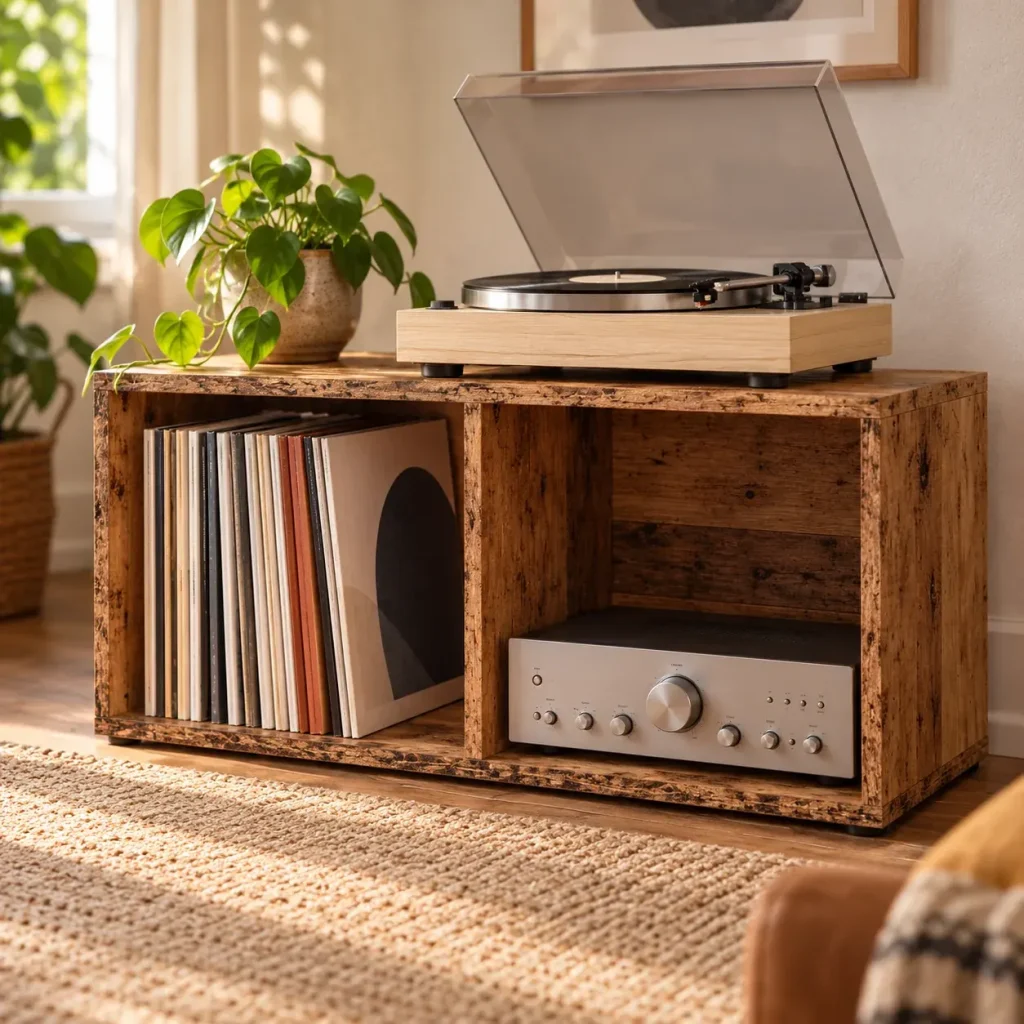
The preamp is a small box that runs cool. Ideally it sits close to the turntable, for short cables, but not right up against the amp. An open recess under the top works well: the preamp stays accessible, and the cables run straight down from the turntable.
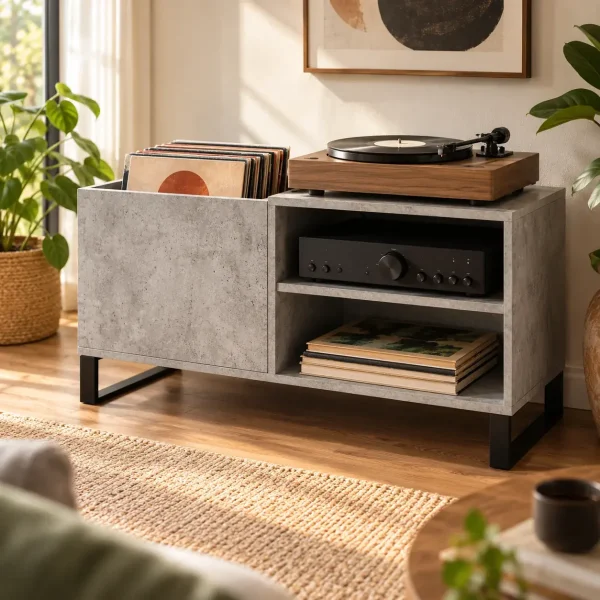
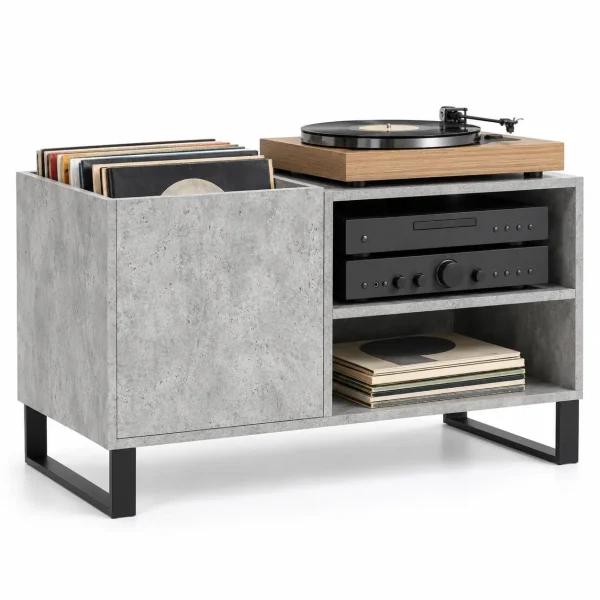
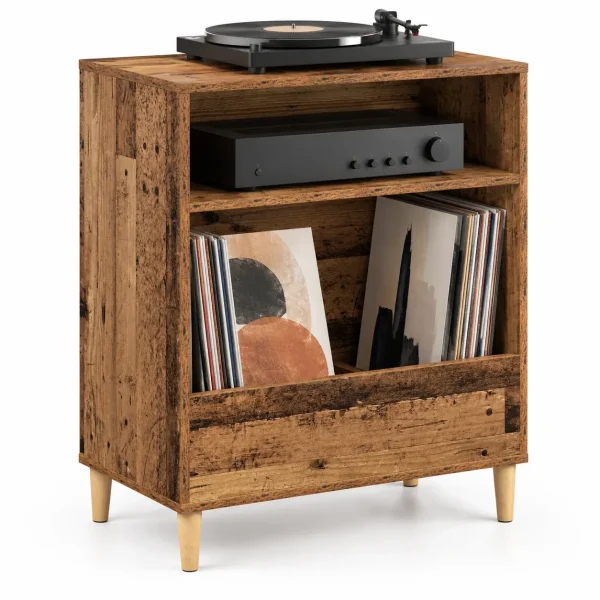
The Abbesses unit combines a record compartment with a recess for the amp, with room for the preamp alongside. Belleville offers one closed compartment and two open recesses, one for the amp and one for the preamp or another source. And Monceau keeps the top clear on slender legs, with a shelf for the amp underneath.
Browse all our hi-fi cabinets with an amp recess, and more broadly our record player stands.
Frequently asked questions
How do I know if my turntable has a built-in preamp?
Look for a PHONO / LINE switch near the RCA sockets, or a mention in the manual. If you find neither, assume it does not have one.
What happens if I use two preamps?
The signal is amplified and corrected twice: the sound becomes too loud, distorted and bass-heavy. Switch one of them off.
Does a phono preamp improve the sound?
First and foremost it is essential: without it, the sound is weak and unbalanced. Beyond that, an external preamp can be chosen to match the cartridge more closely.
Do I need to connect the ground wire?
Yes, if there is one: attach it to the GND terminal of the component receiving the phono signal. It prevents most hum.