A turntable makes no sound on its own: it needs speakers and, between the two, some amplification. That is often what throws people when they first put a system together. Should you go for active or passive speakers? Do you need a preamp? And where should they go so they sound good without disturbing playback? Here is how to choose the best speakers for your turntable and set them up properly.
What a turntable needs to make a sound
The signal coming out of the cartridge is very weak. It has to pass through two stages before it reaches the drivers:
- The phono preamplifier, which boosts the signal level and corrects its bass-treble balance. It can be built into the turntable, the amp or the speaker, or come as a small separate box.
- The power amplifier, which gives the signal the energy needed to move the speaker cones.
Choosing speakers really comes down to knowing where those two stages sit.
Active or passive speakers?
Active speakers
An active (or powered) speaker contains its own amplifier. You simply plug it into the mains and connect it to the turntable. It is the simplest, most compact solution: no extra component to find room for.
One thing to watch: most active speakers expect a line-level signal. So your turntable needs a built-in preamp, or the speakers need a phono input. Some models have a phono / line switch on the back: check before you buy.
Passive speakers
A passive speaker has no amplification built in. It connects to an amplifier with speaker cable. That means one more component, but it gives you plenty of freedom: you can change speakers without changing amp, and vice versa, and upgrade your system one piece at a time.
What about Bluetooth speakers?
With a turntable fitted with a Bluetooth transmitter, a wireless speaker works too. It is convenient, but the signal is digitised and compressed along the way. For focused listening, a wired connection is still preferable.
| Active speakers | Passive speakers | |
|---|---|---|
| Amplification | Built in | Separate amp required |
| Phono preamp | Turntable, speaker or separate box | Turntable, amp or separate box |
| Components to house | Turntable + speakers | Turntable + amp + speakers |
| Upgrading | You replace the whole set | You replace one piece at a time |
The preamp: do not forget it, do not double it
Two mistakes come up again and again. The first: plugging a turntable without a preamp into a line input. The sound is then very quiet, with no bass. The second: stacking two preamps, for example a turntable set to LINE plugged into an amp’s PHONO input. The sound becomes too loud, distorted and unbalanced. The rule is simple: one phono preamp in the chain. Our article on the phono preamp covers this in detail.
Bookshelf or floorstanding: what size of speaker?
Compact bookshelf speakers sit on a shelf, a cabinet or stands. They suit most living rooms and listening corners. Floorstanding speakers generally go deeper in the bass but need space and a little distance from the walls. In a small room, big speakers will not necessarily sound better: the bass can become overpowering. Choose the size to suit the room rather than the other way round.
Positioning your speakers
The listening triangle
For a good stereo image, place the two speakers and your listening position at the corners of a roughly equilateral triangle: the distance between the speakers is close to the distance between each speaker and you. Angle them slightly towards your seat. The tweeters, the small treble drivers, work best at ear height when you are seated.
A little breathing room behind
Pushed against the wall or tucked into a recess, a speaker produces boomy, muddy bass, especially if it has a rear port. Give it some space and adjust by ear. Manufacturers’ manuals often give a recommended distance.
Not on the same furniture as the turntable, if possible
This is the point that is most specific to vinyl. A speaker makes whatever it stands on vibrate. If it sits on the turntable’s furniture, those vibrations travel up to the stylus, which picks them up again: at high volume, this can cause a rumble or even feedback. Ideally, the speakers stand on stands, wall shelves or a separate piece of furniture.
If the speakers share the cabinet
That is not always avoidable. In that case:
- move the speakers as far from the turntable as possible, at either end of the unit;
- isolate the speakers with pads, spikes or damping supports;
- choose a heavy, stable piece of furniture, which vibrates less than a lightweight one;
- be sensible with the volume and the bass.
Which furniture for the turntable and speakers?
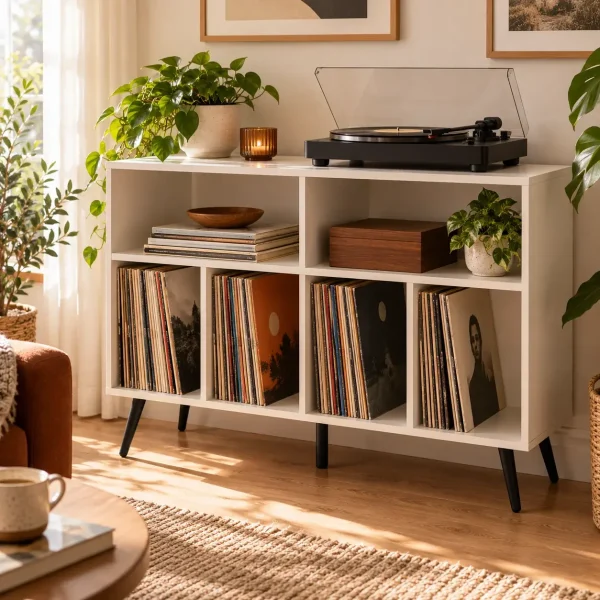
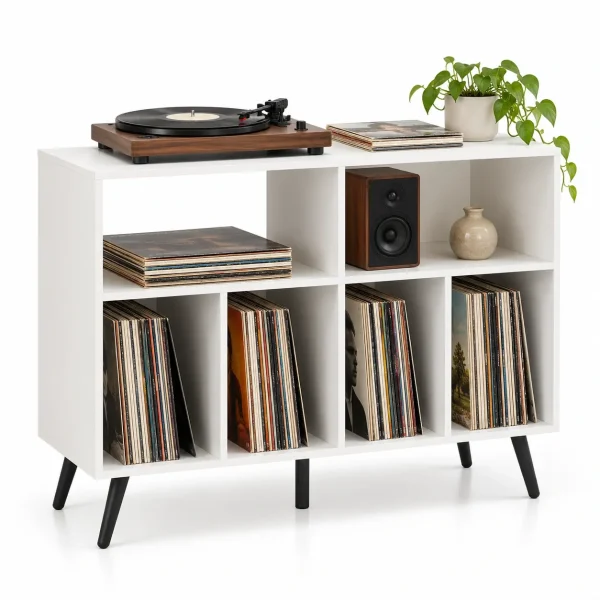
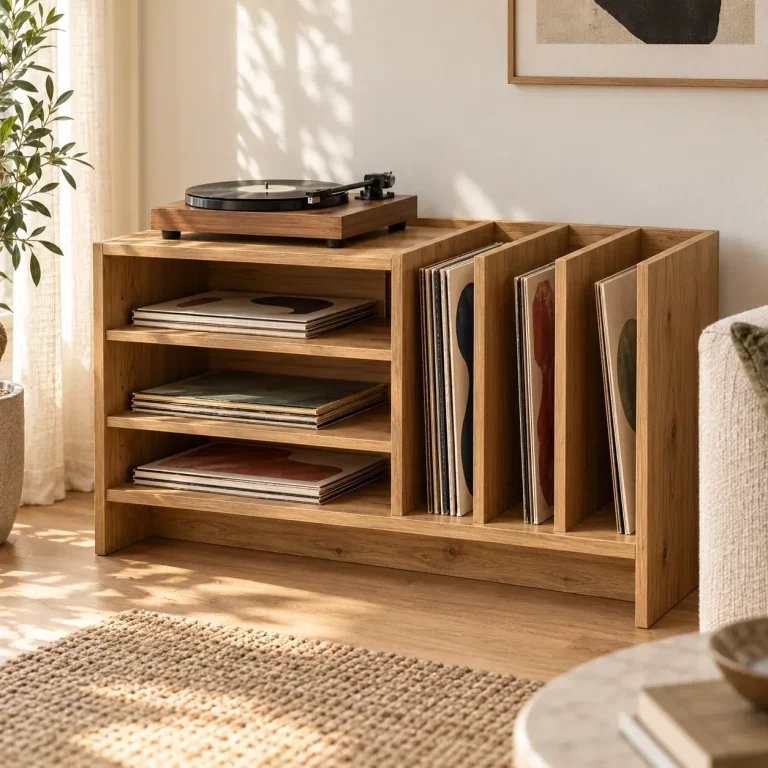
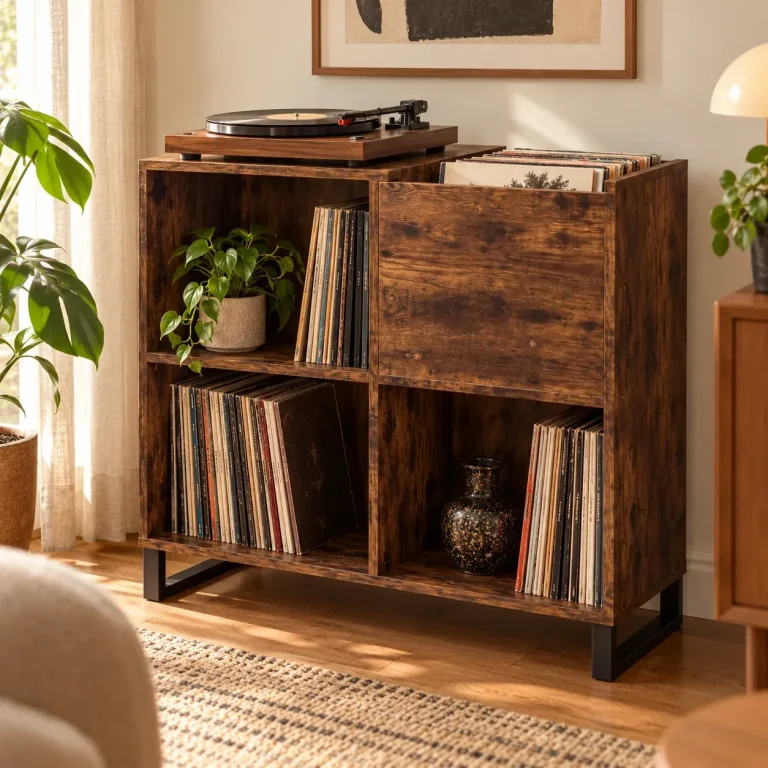
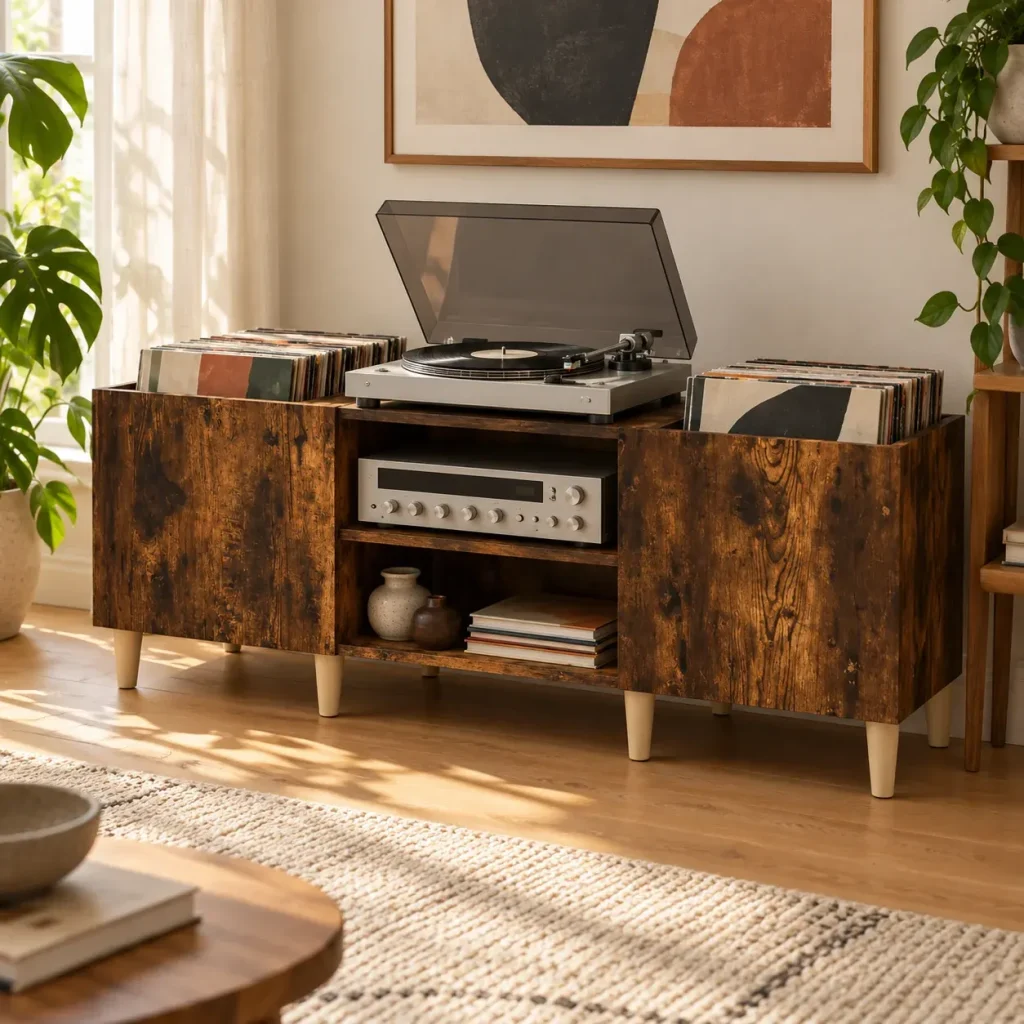
If your speakers need to sit on the same unit as the turntable, length makes the difference: it lets you move them away from the top and get proper stereo separation. The models in our TV and hi-fi units collection, from 100 cm, are designed with this in mind.
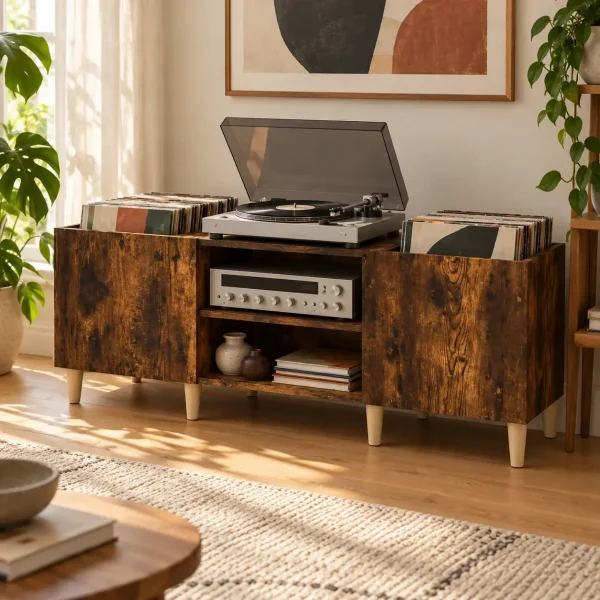
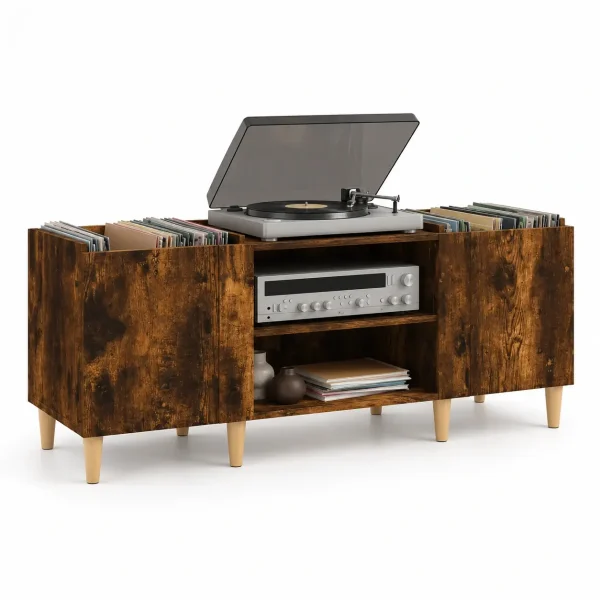
- Bastille (121 cm) has two side doors for records and central recesses for the amp: turntable in the middle, a speaker at each end.
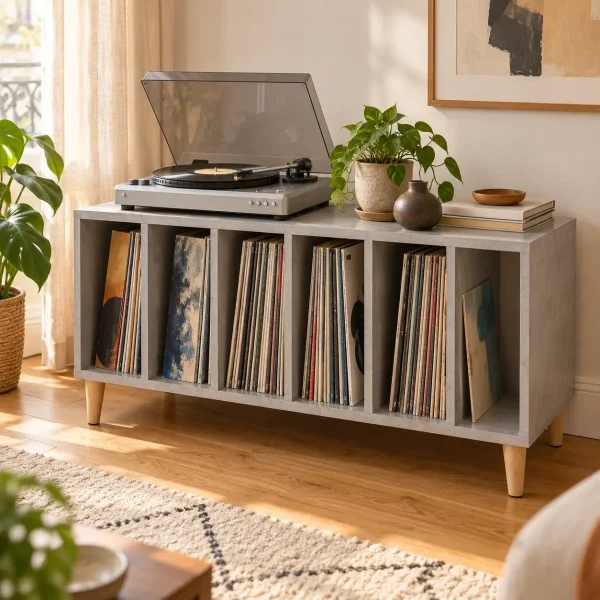
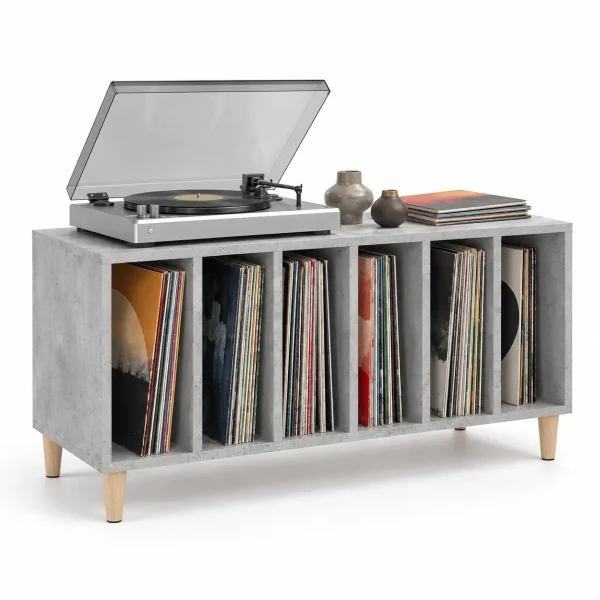
- Oberkampf (100 cm) is a low console with six vertical compartments, suited to bookshelf speakers on stands either side.
- Vaugirard (100 cm) combines two tall recesses and four record compartments on metal legs.
For other lengths, see our selection of large record cabinets, or our full range of hi-fi furniture with an amp recess if you are going for passive speakers.
Frequently asked questions
Can I connect speakers directly to a turntable?
Only active speakers, and only if there is a phono preamp in the turntable, in the speakers or in a separate box. Passive speakers need an amplifier.
Active or passive speakers for a beginner?
Active speakers are simpler and take up less space. Passive speakers, paired with an amp, let you upgrade your system one piece at a time.
Why does my turntable rumble when I turn the volume up?
Most often, vibrations from the speakers travel through the furniture to the stylus. Move the speakers away from the turntable or isolate them.
How far apart should the speakers be?
Aim for a roughly equilateral triangle with your listening position, and leave a little space between the speakers and the wall.